


Key Takeaways
- States are exploring school-owned land as a workforce housing tool.
- Arizona’s SB 1080 would have created a broader redevelopment model than many existing state approaches.
- Local decisions around site use, eligibility, zoning, and public benefit will shape how these policies move forward.
School-Owned Land as a Workforce Housing Strategy
As states continue searching for creative solutions to workforce housing shortages and underutilized public property, policymakers are increasingly looking at school-owned land as a potential development opportunity.
This year Arizona lawmakers considered a notable new approach to addressing workforce housing shortages through redevelopment of unused school property. While the proposal, SB 1080, ultimately saw little movement, it highlights a growing conversation among states about how school districts can leverage underutilized assets to support essential workers.
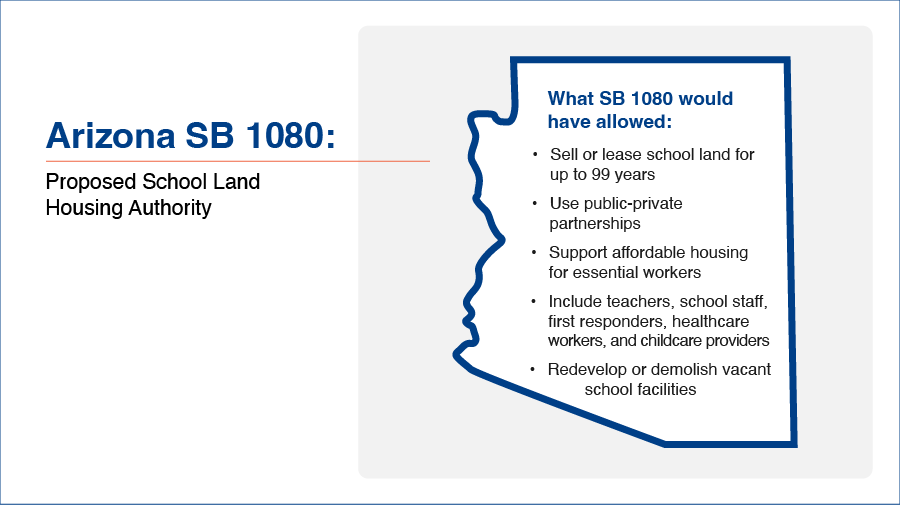
The bill would have authorized school districts to enter into public-private partnerships to sell or lease school buildings and land for up to 99 years without voter approval when tied to affordable housing development for essential workers. Eligible residents would have included teachers and school employees, as well as firefighters, police officers, EMS personnel, healthcare workers, and childcare providers.
SB 1080 also would have allowed districts to demolish, rebuild, or redevelop vacant school facilities as part of these agreements. To approve a project, districts would have been required to obtain an independent analysis of the property’s fair-market value and projected community impact, provide at least 45 days for public comment, hold public meetings with virtual participation options, and secure a two-thirds vote from the school board. Revenue generated through agreements would have been restricted to school facility maintenance and improvements.
How Arizona’s Proposal Compares to Other States
Although other states have explored related policies, Arizona’s proposal stood out for the breadth of authority it would have granted school districts. In South Carolina, HB 3467 allows districts to use surplus property for affordable housing partnerships focused on educators and school employees. In Ohio, SB 311 addresses procedures surrounding unused school facilities, primarily focusing on sales and state oversight. Meanwhile, California has existing laws supporting educator housing projects on underutilized school land through more established statutory frameworks.
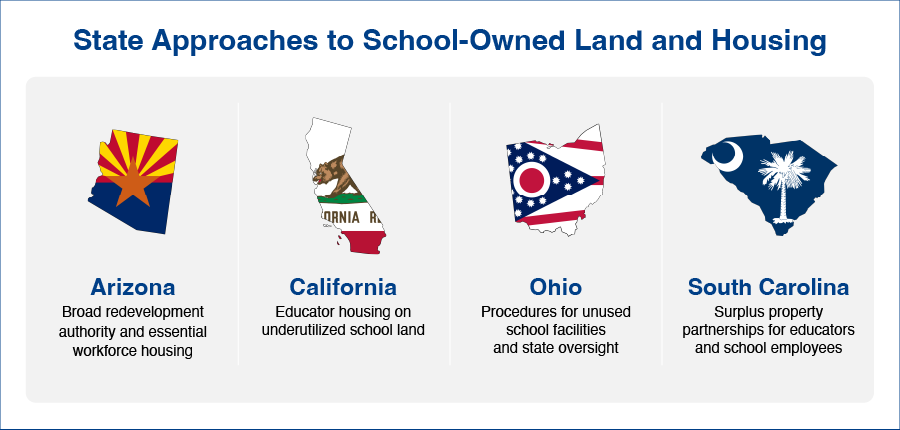
What differentiates AZ SB 1080 is that it combines several policy concepts into a single redevelopment model: long-term public-private partnerships, streamlined approval authority, redevelopment of vacant school sites, and housing eligibility that extends beyond educators to a broader essential workforce population. As housing affordability and workforce recruitment remain ongoing challenges nationwide, proposals like Arizona’s could signal a broader trend states continue to explore in future legislative sessions.
What Happens at the Local Level
Once states create the authority or funding for school districts to use land for housing, the conversation becomes much more specific. Local officials have to decide which sites make sense, how the land should be used, who the housing should serve, and what role the school district, city, county, or private partner should play.
This is where the issue starts to look less like a housing strategy and more like a local land use decision.
In some communities, the first step is determining whether land once reserved for a school is still needed for that purpose. In Douglas County, Colorado, land that had previously been planned for an elementary school is now being considered for affordable housing. The school board voted to declare the parcel surplus, which opened the door for potential housing for teachers and county workers.
In Brunswick County, North Carolina, county commissioners approved setting aside 12 acres for a potential teacher housing project. The school district is considering 24 two-bedroom apartments for teachers, with the goal of offering rents below the local market rate. However, access to land is only one part of the process. A project still needs approvals, financing, site review, infrastructure planning, and a long-term operating structure. Those steps often involve counties, cities, housing partners, school districts, and community members.
In other communities, the question lies not only in whether school land can be reused, but who should benefit from the housing. In Mecklenburg County, North Carolina, county leaders have been considering a proposal to redevelop a former school site into housing for Charlotte-Mecklenburg Schools teachers and county staff. The proposal could include 100 to 300 multifamily units.
In the development proposals, communities are not all defining these projects the same way. Some may focus only on teacher housing, while others may include all school employees. Some may expand the usage to include county workers, first responders, or other public-sector employees. Each approach has different policy and political implications. A teacher-only project may make it easier to address educator shortages, while a broader workforce housing project may address a larger local need, but it can also raise more questions about eligibility, income limits, and public benefit.
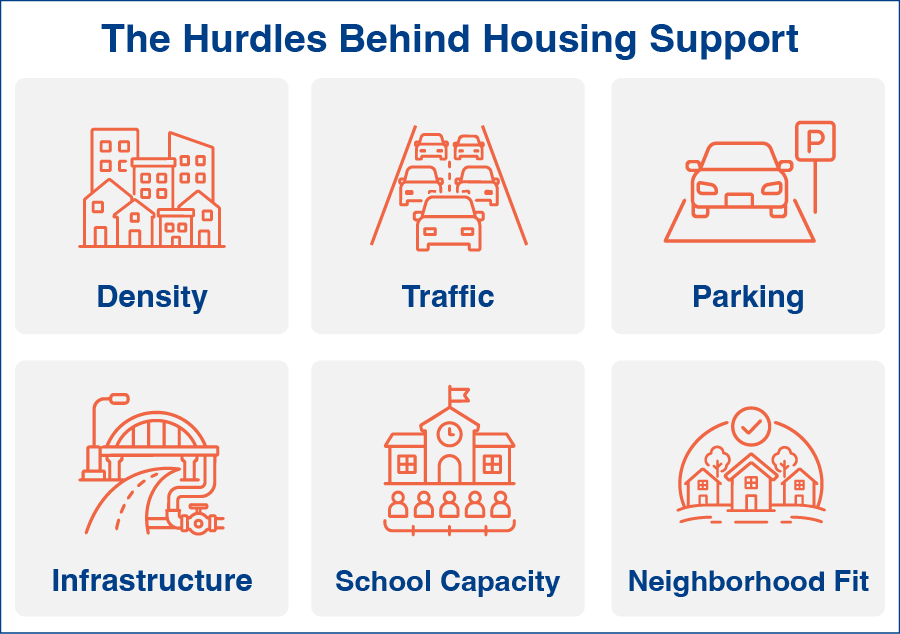
Former school sites are not the same as other public parcels. A closed school may still be viewed as a neighborhood anchor, a gathering place, or one of the few public properties residents still associate with community use. Even when there is support for more affordable housing or teacher housing, local officials may still have to work through concerns about density, traffic, parking, infrastructure, school capacity, and whether the project fits the surrounding neighborhood.
California’s focus on land owned by local educational agencies has helped push this issue forward. In the case of Windsor Unified School District, the city has been exploring the reuse of the former Windsor Creek Elementary School site for below-market-rate housing for teachers, school staff, and community members. The proposal fits well with the state’s interest in using school-owned land to address housing needs, while also raising the local land use and zoning questions that determine whether a project can move forward: what should happen to a former elementary school site, who should be eligible to live there, how the district should balance workforce needs with neighborhood concerns, and what public benefit should remain attached to the land.
Local Decisions Could Shape Future State Policy
Local projects like Windsor can also influence what comes next at the state level. Districts may have land but lack funding for planning, site work, or early development costs. Local officials may want to move forward, but need clearer authority over what types of housing can be built on school-owned property. Communities may support the concept but still debate eligibility, affordability terms, or how long the land should remain tied to a public purpose. Those details, worked out in local meetings and development discussions, often become the evidence used to shape the next round of state legislation.
An educational facilities discussion, surplus land item, or exclusive negotiating agreement may not look like housing policy at first. In this area, however, those items can be the start of a much larger conversation about how public land can be used to meet workforce and affordability needs. By the time a formal development proposal is introduced, the direction of the discussion may already be clear.
Education policy is no longer defined by a single issue or jurisdiction; it’s a multifaceted arena that spans academic standards, workforce alignment, technology access, and the governance of public institutions. Stateside’s Education Practice combines deep policy expertise with strategic engagement capabilities to help you navigate the opportunities and challenges ahead.
If you’d like to learn more about our Education Practice and how it can support your organization’s goals, contact us to start the conversation.
About the writer: Jen Ustynoski, Vice President
Jen joined the Stateside team in August 2022 as Senior Political Director. In her role, she supports the advocacy and relationship-building efforts of Stateside's clients' national, state, and local policy and political organizations. She will also work with elected and policy officials to help communicate the needs of the firm's clients, as well as help create national strategies and engagements using her grass tops experience.