



When a company faces regulatory hurdles or political headwinds, it has many competing considerations: a small budget, limited experience with this kind of risk, a knowledge or talent gap among the company personnel, little or no verified information, time constraints and external pressure from Boards of Directors or investors. For a small startup, it might mean they have never had any public policy or regulatory challenges before and are at risk of making strategic, costly mistakes. For a politically sophisticated legacy business, this scenario could be triggered by a sudden threat from a new competitor, a political opponent, or an unexpected business crisis.
The Danger of the Traditional Approach
Often, the traditional instinct is to quickly hire a well-connected lobbyist. I’ve seen this dozens of times—hiring a friend of a friend or acting on a cold call from a lobbyist who read an article about the company’s challenges. The truth is, sometimes this approach may work, at least initially. Your lobbyist may have all the relationships and connections necessary to get you the information and political intelligence you need. However, companies finding themselves in a time of political or regulatory transition most often need far more. They do not just need a door-opener; they need an architect drawn from a group of experts who’ve guided companies of all sizes through all kinds of these transitions.
A modern public policy approach must specifically move away from solely “hiring a guy with a Rolodex” — an analogue contact management system you can still buy on eBay for a bit of vintage office fun — and toward relying on a political and regulatory expert.

In line with the era of its peak usage, the Rolodex model brings to mind what reporters covering the 1986 tax debate famously dubbed “Gucci Gulch”—the Capitol corridors outside hearing rooms where lobbyists gathered between meetings, trading insights and making connections. And to be fair, there can still be a role and need for that kind of support. But while relationships with policymakers undeniably still matter, relying solely on one individual’s personal connections is no longer sufficient, especially when your business is facing mounting political or regulatory risks. It is unrealistic to expect that model to deliver consistent results in a world with evolving advocacy tools, micro-targeted outreach, innovative message delivery and rapid coalition building.
I’ve also seen the opposite approach fail to deliver. Often an early-stage company with little experience, network or resources uses low-cost tech to try to advocate for its business. Over-reliance on an unfamiliar tech tool can create reputational risk for the business. The lack of human nuance, the inability of the tech to take the political temperature or read the room can exacerbate the issue. Often the reliability of the tech can be difficult to test. All of these risks, combined with messaging drafted by talented business communicators without political experience, can often create a recipe that leaves a bad taste in everyone’s mouth – the company, investors and policymakers.
When disruptive early-stage businesses threaten entrenched interests, those competitors will often stop at nothing to quash the startup. We can think about their strategy as “killing it on the vine.” Tough words, but that is exactly what these legacy competitors want to do – stop your startup before it can get any traction.
Conversely, these same mature businesses that are used to doing things a certain way often find themselves unprepared for a new political landscape, disruptive market entrants, unexpected regulatory threats, and innovative opportunities as the world changes around them. In these transitional moments, whether you are a startup or a legacy business, turning to professional, expert strategic advisory services is essential.
In critical moments of transition, companies need a comprehensive, budget-conscious public policy plan tailored to their unique culture, the industry they are disrupting, and their tolerance for political risk.
The first step is bringing in a strategic advisor to conduct a thorough, clear-eyed audit of existing capabilities. If no program currently exists, this advisor helps decision-makers gauge their risk tolerance, set budget parameters, and determine their appetite for press exposure. Crucially, the advisor will ensure all stakeholders understand the timing and magnitude of the risks at hand—whether addressing an imminent crisis or proactively preparing for the future. This internal alignment is essential for mapping the business’s exact needs to its current resources and identifying the tools that must be acquired going forward.
Building the Modern Toolbox
So, what does this actually look like in practice?
If traditional lobbying is about attempting to secure a vote, working with a strategic advisor is about shaping the entire environment that produces that vote.
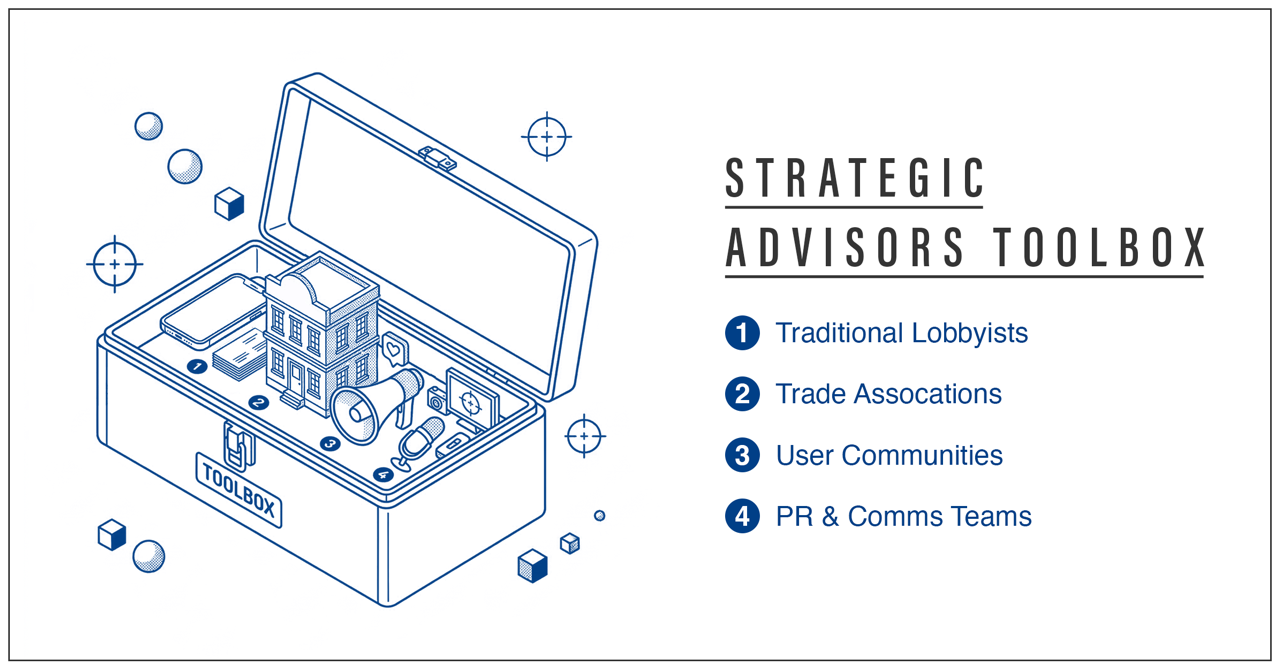
This expert treats every element that could influence a policy outcome as a distinct tool in a comprehensive toolbox. These tools range from traditional lobbyists to trade associations and industry coalitions—because often, the more bitterly companies compete in the marketplace, the more closely aligned they are on public policy. The toolbox also includes leveraging your communities of users, customers, and employees, alongside internal public relations and communications teams to maximize earned and paid media. While there are dozens of incredible tools available, it isn’t the tools alone that deliver success. The strategic advisor’s expertise is the critical element for proper selection, timing, execution, and evaluation of success. After all, owning a hammer and a pipe wrench is helpful, but you still need an expert carpenter and plumber to remodel the bathroom.
The Three Core Elements of Strategy
To successfully shape this environment, the first steps focus on three core elements:
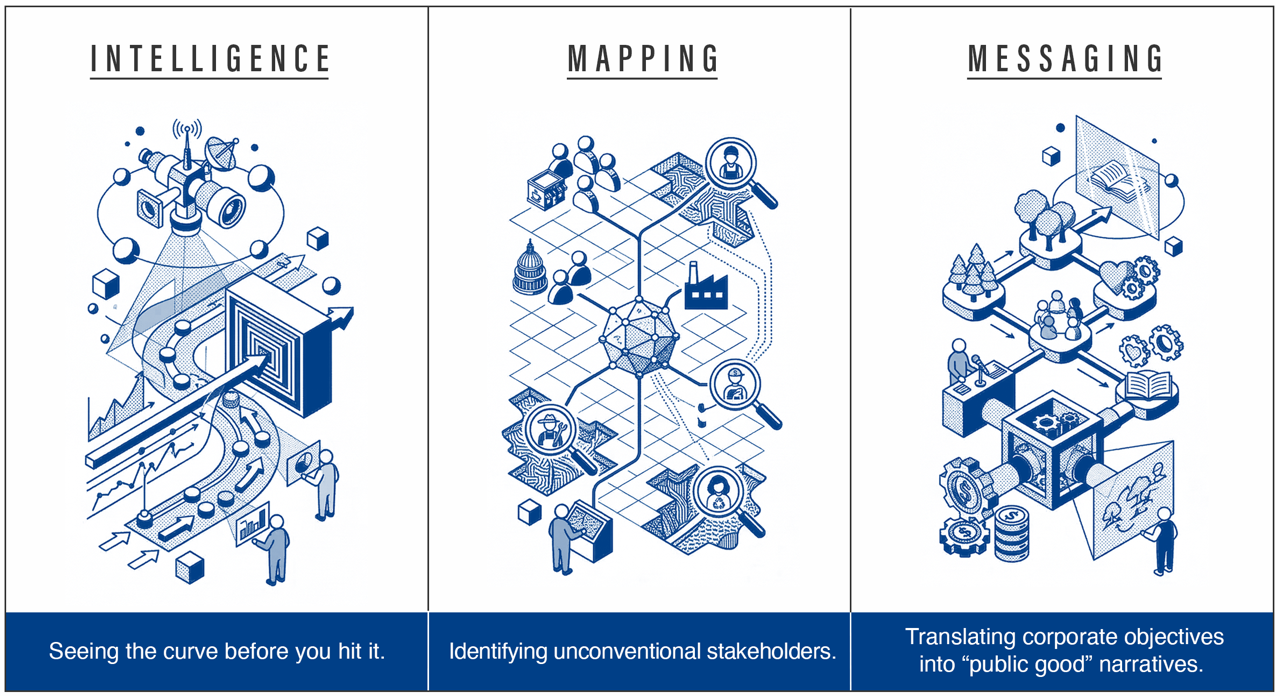
- Intelligence: Seeing the curve before you hit it. Political and policy intelligence functions much like the sensor suite on an autonomous vehicle, allowing you to “see the curve ahead” before you turn. A strategic advisor helps identify where future threats may originate and builds a proactive plan to prepare for political outcomes, even if things seem unclear until election day.
- Mapping: Identifying unconventional stakeholders. Moving beyond just the sponsor of a bill is crucial. With seasoned experience in a wide range of political arenas, the strategic advisor may already know the key players, be familiar with the political landscape in that particular jurisdiction and know the issue. If it’s new to them, they should have access to a vast network to offer guidance and insight. Beyond their own experience and expertise, the advisor will also analyze public accounts and statements, monitor hearing testimony and industry news. All of this can lead to identifying unconventional stakeholders who share a common interest on both sides of the issue.
- Messaging: Translating corporate objectives into “public good” narratives. Folding the intelligence gathering and stakeholder mapping into messaging is critical. To resonate with the policymakers who hold the fate of your business in their hands, corporate objectives will be translated into a narrative ideally centered on the public good. You must draw a direct line demonstrating how supporting your business helps people in a specific community, underserved demographic, region, or market segment. For disruptive businesses, this might involve highlighting how your model brings exciting new participants into an industry in ways that aren’t immediately obvious.
Finally, business leaders must abandon the idea that flying “under the radar” is a viable long-term strategy. Evasion and avoiding regulatory detection do not enhance or grow a business. Policymakers are effectively customers too, and awareness of your business is exactly what you need to grow. It no longer can be considered “a necessary evil” or another expensive cost center.
Public policy advocacy is as critical an investment as cybersecurity, supply chain infrastructure or splashy marketing campaigns.
Just as operational excellence requires hiring a seasoned Chief Financial Officer or a General Counsel, protecting and expanding your business requires a strong public policy program. The great ones make strategic investments in the right people and expert advisory programs that shape public policies leading to business success.
Making that investment is a critical first step; next, as we will cover in Part 2, company leaders must look beyond the federal gridlock of Washington, DC and prepare for the rapid regulatory changes across the nation’s state capitals and city halls. Subscribe so you don’t miss Part 2 and the rest of the series.
Michelle Peacock, Stateside’s Senior Vice President, Strategic Advisory Services, is widely recognized for thoughtfully building programs from scratch and shaping existing programs to meet the evolving needs of businesses at all sizes and stages of growth, including emerging industry disruptors. She has a long track record of successfully developing innovative strategic policy and advocacy programs that protect favorable regulatory landscapes and adapt them to allow for breakthrough business scale.
Strategic Advisory Services enhances Stateside’s consulting services by adding Michelle Peacock’s decades of experience in corporate government affairs and public policy. Strategic Advisory Services provide expert vision strategic guidance during times of complex challenges and change. From emerging companies standing up a government affairs team for the first time, to established industry-leading firms facing unprecedented risks or precipices of change, Strategic Advisory Services brings the experience and expertise to help you successfully navigate the shifting landscape.
Discover our Strategic Advisory Services and let us provide the intelligence, mapping, and messaging tools you need to shape your environment.