



For the past several years, states have been the nation’s de facto AI laboratories. In the absence of comprehensive federal legislation, governors and legislators have stepped in to address algorithmic bias, consumer transparency and disclosure, and risk management. President Trump’s December 11 executive order, “Ensuring a National Policy Framework for Artificial Intelligence,” intends to change that. Framed as an effort to preserve American innovation and prevent a fragmented regulatory landscape, the order sends a clear message: the federal government wants to reclaim primary authority over AI policy and significantly narrow the role states have played as first movers.
From State Innovation to Federal Preemption
The executive order directs the secretary of commerce to undertake a 90-day review of state AI laws and identify those that impose “onerous” burdens on private-sector AI development and deployment. It also directs the attorney general to establish an AI Litigation Task Force to challenge those laws. Based on Stateside’s evaluation, several states may find themselves in the crosshairs for federal preemption.
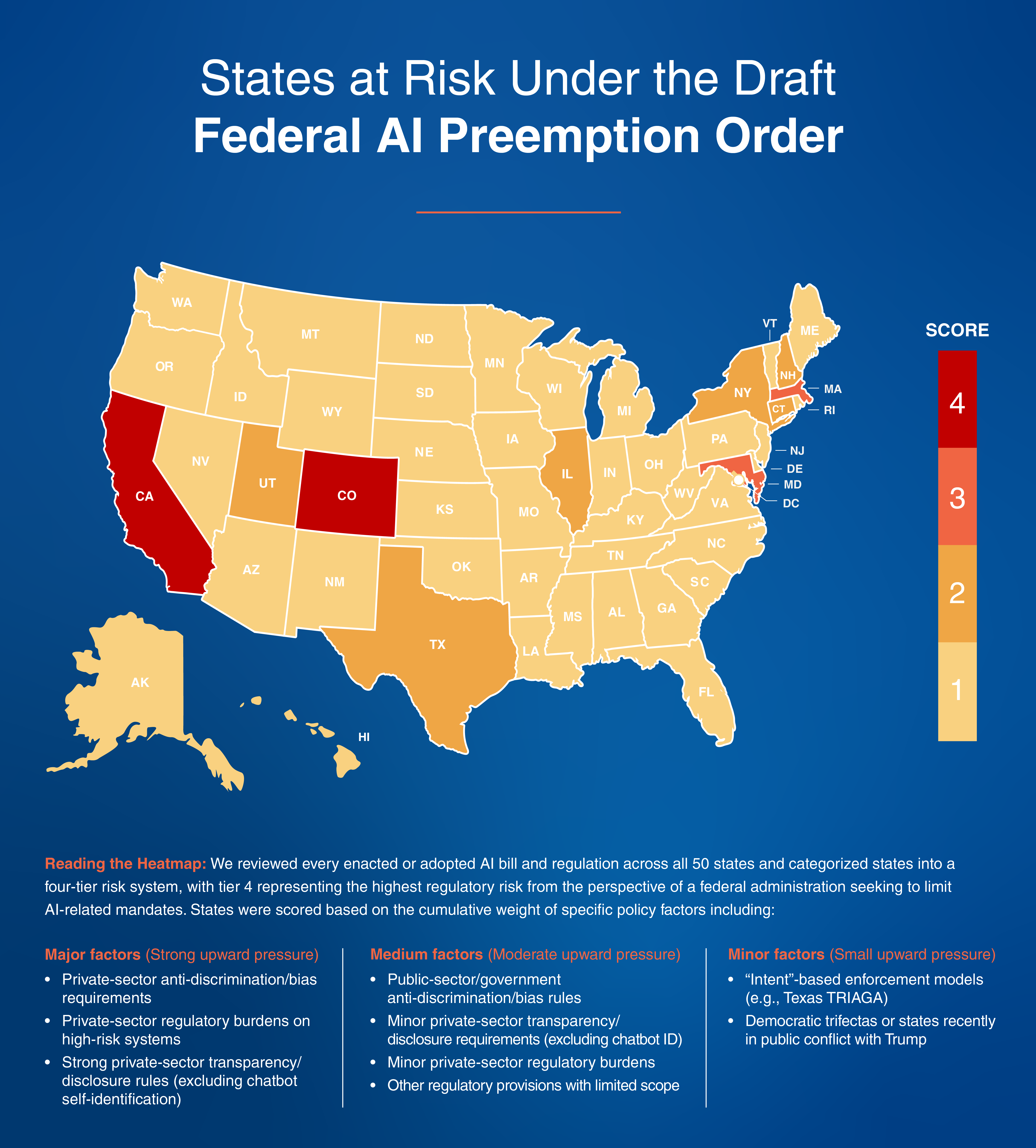
- Colorado’s Artificial Intelligence Act, the first-in-the-nation comprehensive state AI law, was specifically called out in the executive order. The law regulates “high-risk” AI systems used in employment, lending, housing, and insurance. It requires developers and deployers to mitigate algorithmic discrimination, maintain risk-management programs, and provide consumer notices.
- California’s AI transparency and accountability measures require disclosures when AI is used in consumer-facing settings and documentation explaining how certain high-risk systems function.
- New York’s AI disclosure rules for political and commercial content may also be at risk. Though narrower in scope, they require clear labeling when AI is used to generate advertisements or public-facing materials.
Meanwhile, comprehensive AI bills under consideration in states like Illinois, New York, and Virginia may stall while legal challenges to the president’s order play out in court.
The Future of BEAD and Other Federal Funding
One of the most consequential aspects of the executive order is its threat to withhold federal funding to states with “onerous” AI regulations. It directs executive agencies to assess their discretionary funding programs and determine whether they can withhold grants or condition funding on states pledging not to enforce their AI laws.
For state leaders, this transforms AI policy from a purely regulatory question into a fiscal one. The most immediate threat to state funding in the executive order makes states with onerous AI laws ineligible for additional funding from the Broadband Equity, Access, and Deployment (BEAD) Program, established in the 2021 Infrastructure Investment and Jobs Act. States may be eligible for, in total, about $21 billion in BEAD non-deployment funds that can be used for broadband adoption and inclusion efforts like digital skills training, internet affordability programs, and workforce development.
What Comes Next
Previous attempts at federal AI preemption have met with broad and bipartisan opposition from governors, legislators, and attorneys general. Expect any enforcement action tied to the order to be met by a swift legal challenge. That likely lawsuit may further delay the disbursement of BEAD non-deployment and other federal funds.
The state-federal paradigm shift offers some relief for AI companies who have struggled to comply with a patchwork of state regulatory regimes, but it also creates new regulatory uncertainty. Importantly, state laws already on the books remain enforceable unless and until they are challenged.
Some states may delay enforcement or narrow existing statutes; others may wait for courts to clarify how far federal authority extends. In the near term, the executive order seems unlikely to deter legislators, who have already begun pre-filing new AI bills for 2026 legislative sessions.
Robert Williams served in the Commerce Department during the Biden-Harris administration as Deputy Director of NTIA. At Stateside, he continues to track the federal policy conversation as it affects state and local governments, helping clients plan strategic responses to potential impacts on their operations.
Stateside monitors federal policy alongside state and local legislative and regulatory actions. Learn more about how our policy professionals, like Robert and Jake, can assist you.