



When a company faces regulatory hurdles or political headwinds, the traditional instinct is often to panic, break the glass, and quickly hire a well-connected lobbyist to secure a specific vote. As we’ve discussed throughout this series, modern advocacy is not just about hiring a well-connected lobbyist. It’s about shaping the policy environment before the vote ever happens.
To successfully shape that environment, strategic advisors should consider expanding their policy and political toolbox to include deliberate financial collaborations with public policy NGOs and campaign organizations. While this is not the only instrument in the toolbox, engaging with these organizations strengthens the foundational work you have done to monitor issues and engage stakeholders. It visibly demonstrates to policymakers that your company supports their efforts, appreciates their work, and shares a desire for their continued success. Not every organization has the budget, bandwidth, or appetite for these kinds of engagements, and some may not view them as essential. But because strong relationships can contribute significantly to public policy success—and relationship-building is the key objective of these engagements—your organization may want to take a closer look.
Decoding the “Groups” Landscape
Public policy NGOs—frequently referred to by government relations professionals simply as “Groups”—are vital hubs of communication among state and local government officials. These organizations include bipartisan and partisan associations of governors, attorneys general, lieutenant governors, secretaries of state, legislators, regulators, city and county officials, mayors, sheriffs, law enforcement officials, utility commissioners, and nearly anyone else appointed, elected, or holding a gavel.
For corporations, Groups serve as powerful convening organizations. They provide national forums where stakeholders, policymakers, and constituent interests can gather to discuss issues that matter to them, with subject matter experts available to support productive conversation. Participating in these organizations gives your company the opportunity to build the foundational relationships it will need throughout the legislative process.
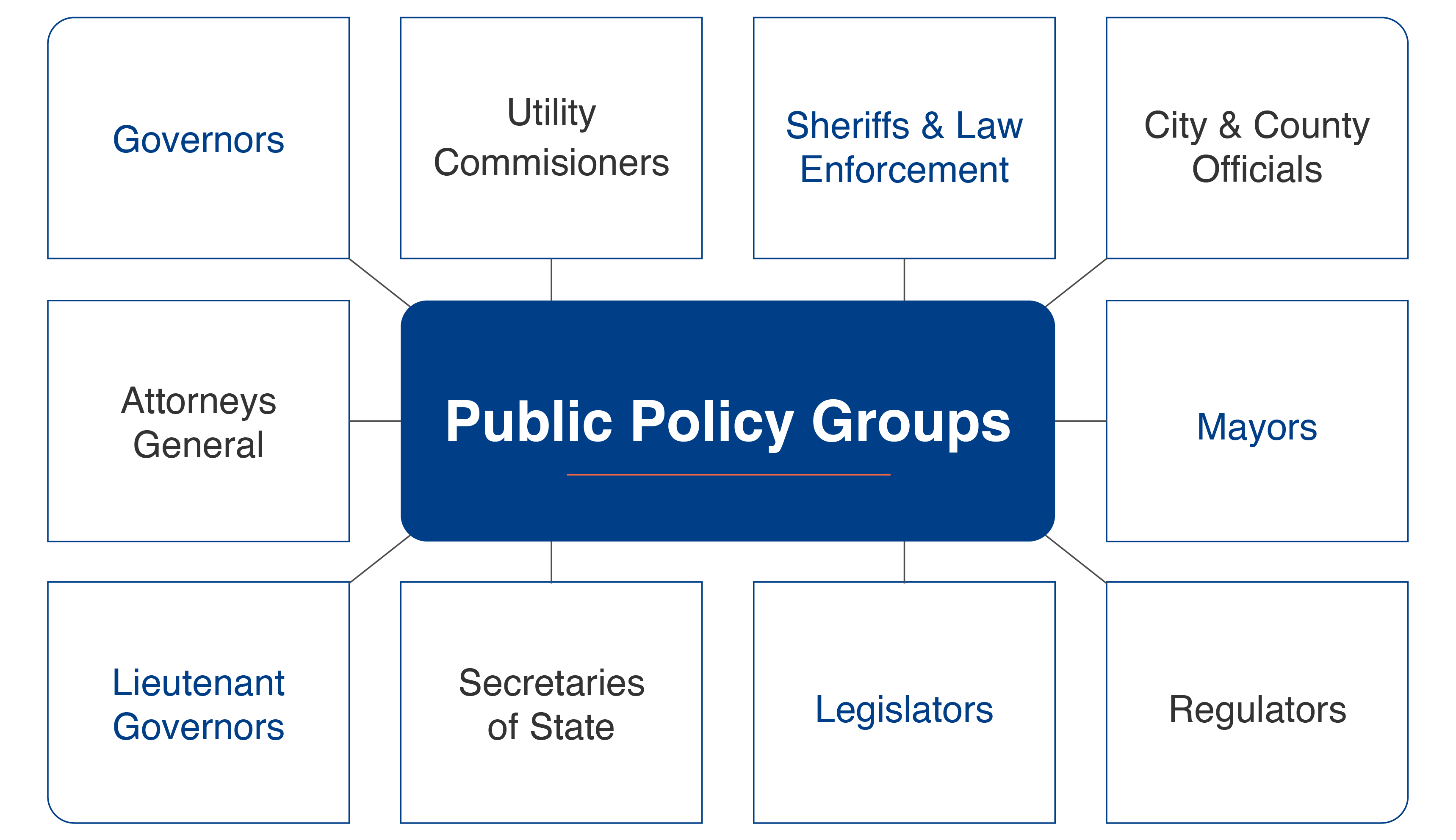
And yet, the “alphabet soup” of state and local Groups can be highly disorienting, even for experienced professionals. Because membership in many of these Groups is strictly limited to government officials, companies must understand how to access them appropriately through event sponsorships. But simply dropping a sponsorship check into the void is rarely enough. Success requires critical “in-between meeting work” with your own team, as well as with Group leadership and staff. It also requires arranging special briefings, and continuously monitoring Group activities to maximize the value of the events themselves.
Understanding 527 Organizations
Beyond policy-focused Groups, modern corporate strategy frequently involves engaging with 527 organizations. Named after Section 527 of the Internal Revenue Code, these tax-exempt political committees operate at the national, state, and local levels.
Strategic Alignment: The Matrix and the Narrative
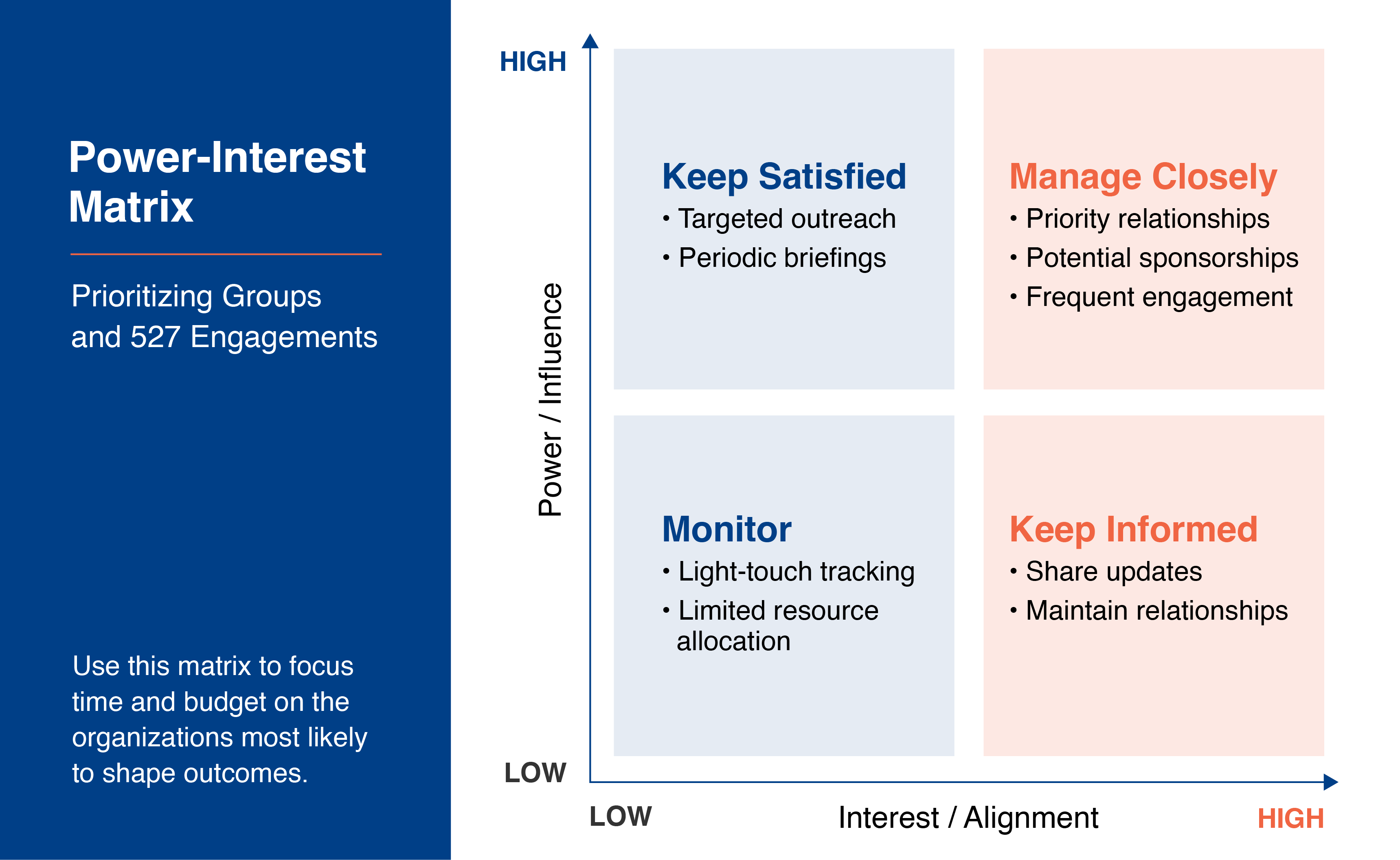
Because there are so many policy-oriented Groups and political 527s—and because corporate resources are finite—you cannot sponsor them all. To decide which organizations deserve your time and budget, use the Power-Interest Matrix.
By plotting organizations on this matrix, you can identify which highly influential Groups have the power to affect your desired outcome and therefore require close management and potential financial sponsorship. You can also determine which highly passionate but less powerful Groups should be monitored and kept informed.
Once you have identified the right Groups to engage, you must translate your corporate objectives into a “public good” narrative. Whether you are forming an alliance with a mission-driven NGO, a policy organization, or a political committee, a public good narrative transcends politics. Draw a direct line showing how your product, technology, or resource benefits the communities in which these officials operate, underscoring that your interests and their constituents’ interests are aligned.
Securing the Home Front: Educating the C-Suite
Partnering with and financially supporting campaign organizations carries significant weight. Consequently, executive leadership must never be caught by surprise by the cost or the highly public nature of these initiatives. C-suites leaders generally dislike surprises, especially those with a hefty price tag.
When it comes to funding 527s and political Groups, companies new to the space typically make one of two mistakes: they either jump in too aggressively, believing it is the only way to be heard, or they resist the strategy entirely, concerned about reputational risk or doubtful of its effectiveness.
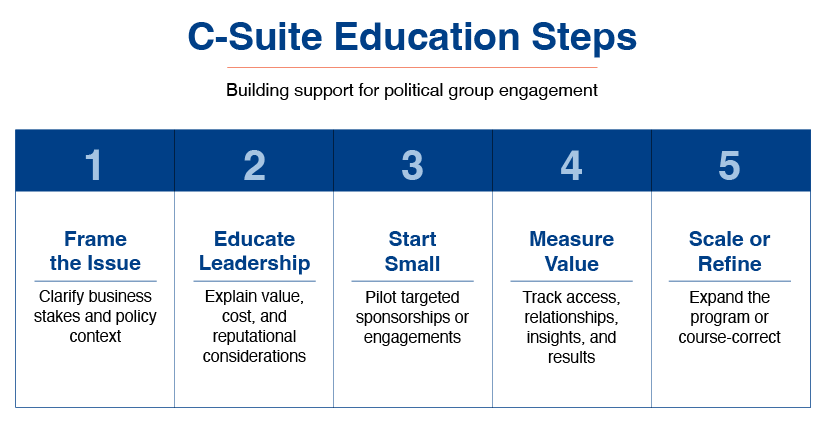
To overcome this internal friction, a government relations team must proactively educate the C-suite. Bring in credible voices to arm your policy team with specific examples of how these sponsorships have successfully driven results for similarly situated companies. The most effective approach is a thoughtfully designed strategy that scales over time: start small, prove that the value exists and that these engagements open doors with decision-makers, and then scale up the budget—or course-correct if refinement is needed.
The Crosshairs of Compliance
Finally, engaging financially with campaign and political organizations places a bright, unblinking spotlight on your company. Regulators and watchdogs frequently keep government relations teams in their crosshairs. Investigations may also mean your company’s internal records and communications are subject to public records requests.
Before undertaking any financial collaboration with a 527 or political Group—or making campaign contributions of any kind—legal compliance is non-negotiable. While 527s enjoy financial flexibility, they are still subject to rigorous disclosure laws, which each state can and will update or modify regularly.
Because campaign finance and ethics laws change constantly, scaling a political contributions program requires a strong legal partner. Decisions must be coordinated at the highest corporate levels before any contributions are made. Your team must work hand in hand with specialized legal counsel to ensure it is never caught off guard by changing contribution limits, new reporting requirements, or unexpected public disclosures.
It sounds like an immense amount of work—and it can be. But when properly executed, engaging with Groups and 527s ensures your voice is heard by the people making decisions that affect your business. These engagements create new opportunities to build relationships with decision-makers, opening a versatile and valuable communications channel. By treating these organizations not as a necessary evil, but as a critical investment in relationship-building, you can help shape the public policies that lead to long-term business success.
Discover our Strategic Advisory Services and let us provide the intelligence, mapping, and messaging tools you need to shape your environment.
Michelle Peacock, Stateside’s Senior Vice President, Strategic Advisory Services, is widely recognized for thoughtfully building programs from scratch and shaping existing programs to meet the evolving needs of businesses at all sizes and stages of growth, including emerging industry disruptors. She has a long track record of successfully developing innovative strategic policy and advocacy programs that protect favorable regulatory landscapes and adapt them to allow for breakthrough business scale.
Strategic Advisory Services enhances Stateside’s consulting services by adding decades of experience in corporate government affairs and public policy to support organizations in critical moments of transition. Startups or legacy businesses may face new political landscapes, disruptive market entrants, unexpected regulatory threats, and innovative opportunities. A partnership with Strategic Advisory Services will provide perspective, support and seasoned expertise to guide them as they develop comprehensive, budget-conscious public policy plans tailored to their unique culture, the industry they are disrupting, and their tolerance for political risk.
Stateside’s unique vision and guidance provides essential intelligence, mapping and messaging so companies can effectively navigate an ever-shifting landscape and flourish in uncertain conditions.