



For years, state technology policy conversations have largely centered around innovation, economic development, privacy, and consumer protection. But a new trend is beginning to emerge across state legislatures: policymakers are increasingly exploring ways to generate revenue from the digital economy itself.
From digital advertising taxes to proposals targeting social media platforms and app-based ecosystems, states are beginning to ask a broader question: should large technology companies contribute more directly to addressing the societal and fiscal impacts associated with the digital economy?
While many of these proposals are still early-stage and face significant legal and political hurdles, the trend itself is notable and likely to grow in importance over the next several years.
A Shift Beyond Traditional Regulation
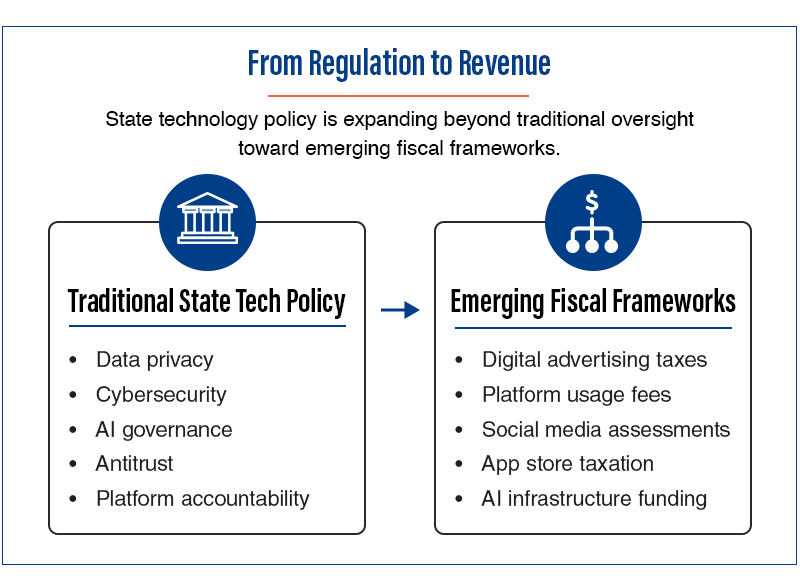
Historically, state technology policy has focused on issues such as:
- Data privacy and cybersecurity
- Online safety protections
- Artificial intelligence governance
- Antitrust and competition concerns
- Content moderation and platform accountability
Increasingly, however, legislatures are moving beyond regulatory frameworks and beginning to examine fiscal frameworks as well.
This includes discussions around:
- Digital advertising taxes
- Platform usage fees
- Social media-related assessments tied to youth mental health initiatives
- App store taxation models
- Data monetization-related penalties and fees
- AI and digital infrastructure funding mechanisms
At the core of many of these proposals is a growing belief among policymakers that large technology platforms play a significant role in shaping public health, education, workforce dynamics, and civic discourse, and therefore may bear some responsibility for helping fund solutions to those challenges. Take digital advertising tax legislation for example. Nearly a dozen states have introduced legislation that would seek to tax digital advertisers, but just Maryland and Utah have been successful in passing standalone, platform-targeted ad taxes.
In 2021, Maryland was the first in the nation to pass legislation, which calls for a graduated tax rate on large platforms (at least $100 million in global annual gross revenues) to be levied on annual gross revenues derived from digital advertising services in the state. While the tax is both legally effective and actively being enforced, the tax is currently the subject of litigation centered around, among other issues, the “pass-through ban” included in the legislation. The U.S. Court of Appeals for the Fourth Circuit ruled the pass-through ban is a content-based restriction that violates the First Amendment. This ruling struck down the pass-through prohibition but left the actual tax intact, meaning large platforms must still pay the gross receipts tax, but they are now legally permitted to explicitly pass that cost down to advertisers as a clear, separate surcharge on their invoices.
Using lessons learned from Maryland’s bill and its subsequent litigation, Utah passed their version of digital advertising tax legislation this year but did so with a novel term of art to describe the tax. Instead of using “digital advertising,” Utah instead codified a “targeted advertising tax” set at a rate equal to Utah’s general state sales tax. In doing so, Utah is seeking to avoid issues related to the federal Internet Tax Freedom Act, which prohibits discriminatory taxes on electronic commerce. Regardless of Utah’s creative attempt to circumvent any federal preemption concerns, Utah’s new targeted advertising tax is likely to also be the subject of litigation before or immediately after the legislation goes into effect on January 1, 2027.
Why States Are Exploring These Ideas
Several factors are driving this shift.
Budget Pressures and Revenue Diversification
States continue to face long-term budget pressures tied to healthcare costs, education funding, infrastructure modernization, and workforce development needs. At the same time, policymakers are searching for revenue sources that do not directly increase taxes on individual residents.
Large technology companies, many of which operate across state lines and generate substantial digital advertising and platform revenue, have increasingly become part of that conversation.
The Rise of the Digital Economy
The modern economy has shifted dramatically toward digital platforms, online advertising, cloud services, AI infrastructure, and data-driven business models. Many state tax structures, however, were designed for a much more traditional economy.
As a result, legislatures are beginning to evaluate whether existing tax systems adequately capture value generated through digital commerce and platform activity.
Public Pressure Around Social Impacts
Youth mental health concerns, online safety debates, algorithmic transparency, and concerns around misinformation have all intensified scrutiny on social media and technology platforms.
In some states, lawmakers are beginning to connect these concerns to funding conversations, particularly around mental health services, education initiatives, and digital literacy programs.
This mirrors historical approaches states have taken with other industries viewed as having broader societal impacts, where policy discussions eventually evolved beyond regulation into taxation or dedicated funding mechanisms.
What This Means for Technology Companies
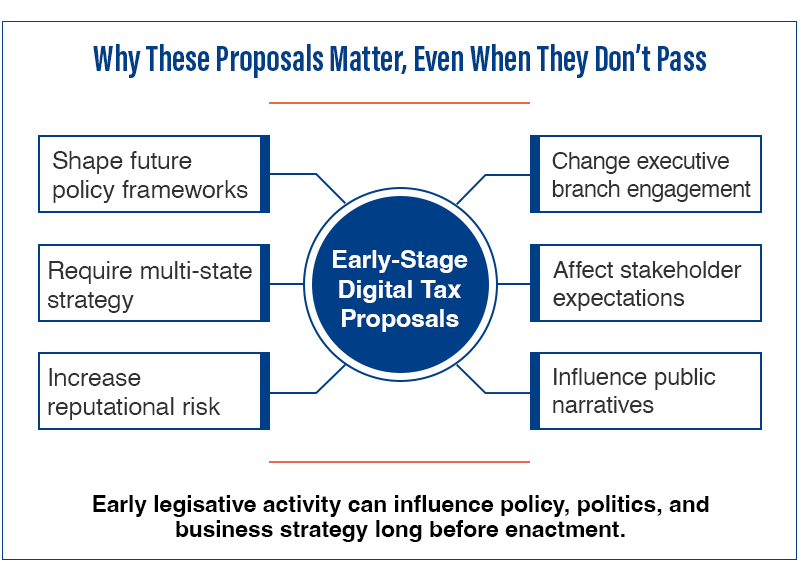
Even when these proposals do not advance, they matter.
Early-stage legislation often shapes future policy frameworks, public narratives, and stakeholder expectations. It can also influence how governors, attorneys general, and legislative leaders engage with technology companies moving forward.
For companies operating in the technology sector, this environment reinforces the importance of:
- Proactive state engagement
- Executive branch relationship-building
- Monitoring emerging multi-state trends
- Coalition development
- Long-term public policy and reputational strategy
The conversation is no longer solely about compliance. Increasingly, it is about how technology companies position themselves within broader discussions around state fiscal strategy, economic development, and public impact.
Looking Ahead
Technology policy at the state level is entering a new phase.
As states continue grappling with the opportunities and challenges created by the digital economy, discussions around taxation, platform responsibility, and digital revenue generation are likely to become more common.
Whether these efforts ultimately result in new tax structures or simply shape broader policy conversations, one thing is clear: the relationship between states and technology companies is evolving rapidly, and the next generation of state tech policy may be defined as much by economics and revenue strategy as by regulation itself.
How Stateside Can Help
As these issues continue evolving across the states, companies will need more than traditional bill tracking. They will need strategic partners that can help identify emerging trends early, assess political and regulatory risk, and navigate increasingly complex state policy environments.
Stateside Associates helps companies monitor and analyze emerging technology policy trends across all 50 states, engage with key policymakers and stakeholders, and develop coordinated multi-state strategies that align government affairs, business objectives, and long-term reputational considerations.
From digital taxation proposals and AI regulation to online safety legislation and broader technology modernization initiatives, Stateside’s integrated approach combines legislative intelligence, issue management, strategic engagement, and on-the-ground state relationships to help clients stay ahead of rapidly evolving policy conversations.
About the Writer: Michelle "MJ" Jones
As Senior Vice President of Government Affairs and Strategic Growth, Michelle "MJ" Jones leads the strategic expansion of Stateside’s Extended Workforce program, an agile initiative designed to scale government affairs capabilities.
She brings more than two decades of experience in government affairs, public policy, and cross-sector strategic partnerships. Ms. Jones is widely recognized for her ability to navigate complex policy environments, cultivate bipartisan coalitions, and develop high-impact advocacy strategies at both the state and federal levels. Throughout her career, she has also demonstrated a strong track record of building high-performing teams and fostering a culture of excellence, ensuring that organizational goals are met with clarity, collaboration, and accountability.