



Introduction
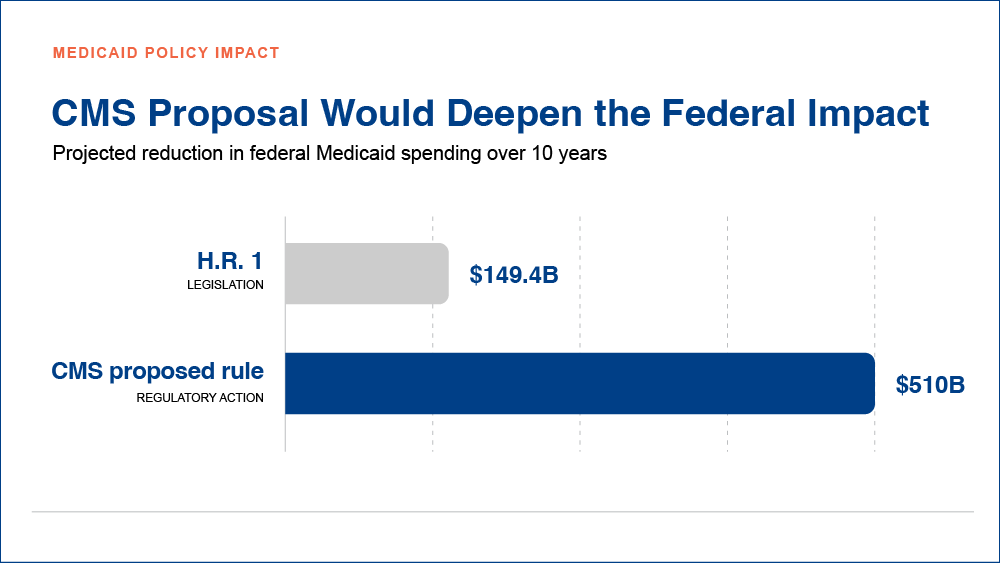
The new Medicaid work requirements being implemented by the “One Big Beautiful Bill Act” (OBBBA, hereinafter H.R. 1) have attracted considerable backlash for creating barriers that will cause millions to lose their healthcare coverage. Less known, however, is how H.R. 1 makes cuts to state-directed payments (SDPs), a tool that states rely on to increase managed care payments to providers. H.R. 1 is mandating drastic cuts to this federal provider funding, and to make matters worse, the Centers for Medicare and Medicaid Services (CMS) has proposed a rule that goes far beyond these cuts. H.R. 1 is projected to slash $149.4 billion in federal Medicaid spending over 10 years, whereas CMS estimates $510 billion in cuts from its proposed rule, over three times H.R. 1’s expected impact.
What are State-Directed Payments?
When state Medicaid agencies contract with managed care plans (MCPs), the state pays the plan a fixed periodic payment on a per enrollee basis, otherwise known as a capitation payment. The state cannot direct how managed care plans spend the capitation, such as the amount or frequency of payments. However, the state may direct how the plan pays its providers through state-directed payments (SDPs). CMS created SDPs to help states achieve their objectives for delivery system and payment reform under Medicaid MCP contracts. The SDP mechanism permits states to require MCPs to adopt:
- Minimum or maximum fee schedule: Intended to support timely access to high-quality, integrated care. Establishing a minimum reimbursement rate helps to retain enough provider participation in Medicaid, and setting a maximum reimbursement helps to control costs and sustain overall coverage for Medicaid members.
- Value-based purchasing model: Prioritizes improved health quality and access outcomes, rather than volume of services delivered.
- Uniform rate increase for particular services: Requires MCPs to make payments on top of their base payment rates. This is intended to enhance services and access instead of benefiting specific providers.
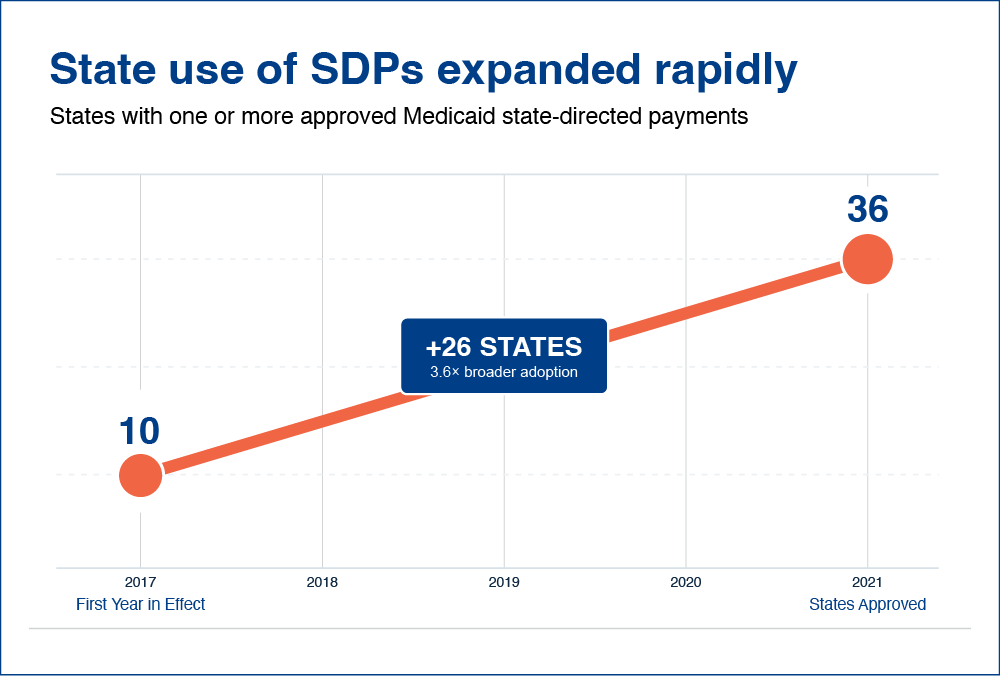
Since SDPs were implemented in 2017, they have become more widespread and used more frequently by the states. A GAO report showed that 36 states were approved for one or more SDPs in 2021, a sizable increase from just 10 state approvals in 2017. Directed payments were also utilized during the COVID-19 pandemic as a means of increasing provider payments under managed care plans. Given their versatility and widespread adoption, SDPs help states to prioritize outcome-focused care and incentivize providers to participate in Medicaid, thus enhancing access to care for low-income patients.
Impending Restrictions on State-Directed Payments
H.R. 1 proposes caps on four service types: inpatient and outpatient hospital services, nursing facility services, and qualified practitioner services at academic medical centers. However, when implementing this requirement, CMS proposed to apply the cap to all SDP services. The SDP caps are being reduced from the average commercial rate to Medicare-based rates and, when services do not have a Medicare rate, the state must use the Medicaid state plan rate. This means services without a Medicare rate would be capped at state plan rates, effectively eliminating SDPs for services like maternal health, pediatric, and home and community-based services (HCBS).
Initially, H.R. 1 applied the SDP caps to 50 states and the District of Columbia, yet CMS’s rule expanded the caps to include U.S. territories with rating periods that begin on January 1, 2029. This includes Puerto Rico, which, since 2023, has had 19 SDPs approved, amounting to $992,546,531 in federal Medicaid funding. Applying the SDP limit to territories would only exacerbate the unique healthcare challenges they face. Unlike the states and D.C. which receive open-ended Medicaid funding, the Medicaid funding for U.S. territories is capped. Once U.S. territories reach their cap, the territory is responsible for paying all remaining Medicaid costs, which can result in providers not receiving payments and critical services being suspended.
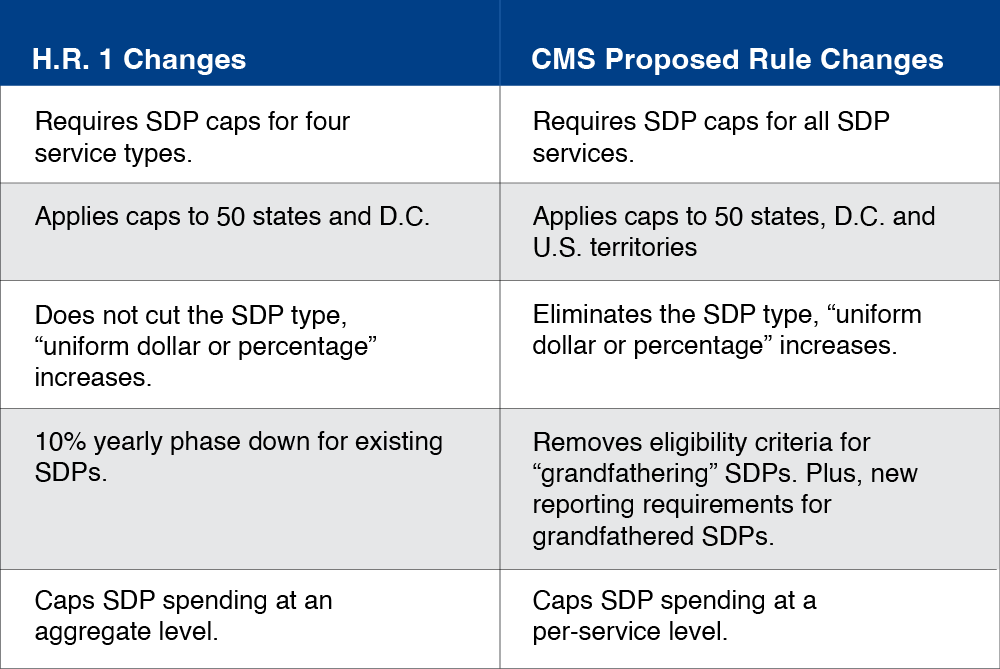
Starting with rating periods on or after January 1, 2028, CMS proposes to do away with the SDP option for a “uniform dollar or percentage” increase. This change is perhaps the most consequential and detrimental, as it makes up two-thirds of SDP spending. This change has no basis in H.R. 1, which does not require uniform increase SDPs to be eliminated. CMS is placing an unwieldy administrative burden on states that will need to restructure the aggregate percentage increases into other types of SDPs, like a minimum or maximum fee schedule. These changes are being proposed while states are still scrambling to develop and implement the Medicaid work requirements. Eliminating the uniform increase option could prove nonviable for states and threatens funding for providers who would then be less inclined to accept Medicaid patients.
Under H.R. 1, states must phase down their existing SDPs (a.k.a. “grandfathered SDPs”) by 10 percentage points annually starting on January 1, 2028. To qualify for this phase-down, an SDP must meet any of these three criteria:
- Standard SDPs: Granted prior approval (or demonstrated a good faith effort) before May 1, 2025.
- Rural Hospital SDPs: Granted prior approval (or demonstrated good faith effort) by July 4, 2025.
- Completed Preprints: Had a fully completed preprint submitted before July 4, 2025.
CMS narrowly defines a “good faith effort” as submitting a completed preprint before the statutory cutoff. This excludes informal consultations and managed care contract notes from qualifying as proof of a good faith effort. Combined with new reporting requirements, many states will fail to meet these stringent rules and subsequently lose their grandfathered status. This will force many states to immediately comply with the lower SDP caps, abruptly cutting their SDP funding. This expedited grandfathering process is projected to reduce federal SDP spending by $17 billion over the next decade.
Even though H.R. 1 only set caps on SDPs at an aggregate level, CMS once again overstepped and proposed a cap on a service-by-service basis. To accommodate this change, CMS encourages states to use Medicare rates to set the Medicaid payment rates. The problem is that Medicare rates are calculated using methodologies designed for completely different patient populations and clinical circumstances. Payment methodologies also vary by state and are adopted to account for factors that are not considered in Medicare methodologies. These variables could make it impossible to consistently and accurately price Medicaid claims across states. There is no good reason for CMS to stray from calculating SDPs at the aggregate level, an approach that CMS has used for decades to calculate upper payment limits for Medicaid inpatient and outpatient services.
What Comes Next for States and Medicaid Providers
The funding cuts and regulatory changes to SDPs will hinder healthcare access for Medicaid beneficiaries, primarily harming: children, pregnant women, the elderly, people with disabilities, and underpaid Medicaid providers. Perhaps by design, CMS has left states with little recourse and time to prepare for the looming federal cuts. While the benefits are limited, Medicaid agencies can spend this time converting the uniform increase SDPs into minimum or maximum fee schedules before 2028. Once the rule is finalized, states will have a strong case to pursue litigation against CMS on the basis that it exceeded its statutory authority. In the meantime, however, a drawn-out legal battle will leave Medicaid providers and their patients to suffer the consequences.
About the Writer: Cody Austin joined Stateside as a Regulatory Associate in August 2022. Originally from upstate New York, Cody graduated magna cum laude from SUNY Geneseo with a B.A. in English Literature. He has worked in law firms in Rochester, NY, and served in a supervisory role at SUNY Jamestown Community College. Cody moved to Washington, D.C. to pursue a Master of Arts in Government at Johns Hopkins University. He has canvassed for voting rights around the DMV area and enjoys gaming, reading, and spending time with his Corgi named Waffles.
Stateside’s Healthcare Practice helps organizations anticipate and respond to the legislative and regulatory changes reshaping healthcare at the state and federal levels. From Medicaid financing and reimbursement policy to implementation timelines and state-specific requirements, our team provides the intelligence and strategic guidance clients need to understand their exposure and prepare for what comes next. As H.R. 1 and CMS’s proposed rule threaten significant reductions to state-directed payments, healthcare providers, plans, and stakeholders must assess the potential impact now.
Contact Stateside to understand how these changes could affect your organization and develop a strategy for navigating the evolving Medicaid funding landscape.