


Large load customers, including data centers, are continuing to navigate a complex arena of policy, regulatory, and public perception across the U.S. as state lawmakers and federal officials race to address rapid demand growth.
The White House’s Ratepayer Protection Pledge (“RPP”) announced on March 4, 2026, in conjunction with leading American hyperscalers and AI companies, establishes a framework to support AI development and safeguard energy consumers. The pledge stipulates five pillars:
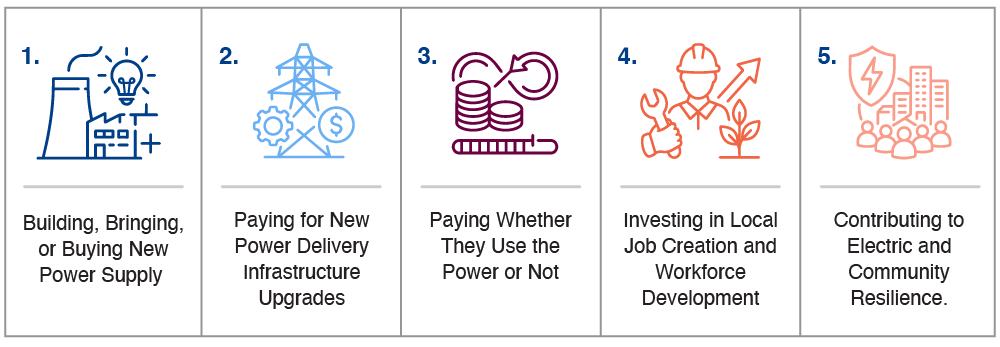
The pledge was a notable first federal effort; however, it is part of an ongoing trend seen in state legislatures and regulatory constructs across the country. This year, state legislators are proposing, developing, and passing a wide array of solutions that aim to protect residential ratepayers and encourage economic development. At the regulatory level, public utility commissions are approving cases that embody similar principles that state legislators are requiring.
LEGISLATIVE DEEP DIVE
The most common state-level legislation has been the creation of distinct regulatory tracks to ensure that large loads and data center operators are paying whether they use the power or not – a key component of Pillar 3 of the RPP. Seven states have proposed some iteration of this pillar. Alaska’s HB 259 mirrors the RPP’s "take-or-pay" structure by requiring large energy facilities (with a peak demand of 20 MW or more) to pay for at least 80% of their contracted amount, regardless of actual purchases. Similarly, Georgia’s SB 34, requires utilities to negotiate contracts with large load customers (100 MW or more) that include minimum billing requirements. New specialized customer classifications for large loads are seen in California, AB 2383, and Delaware, HB 233. Through these measures, states reduce the socialization of costs and risk across the broader ratepayer base.
Beyond structured contracts, states are requiring large loads to build, bring, or buy new power supply required to meet their demand. HB 2457 / SB 1418, in Arizona, allow utilities to bypass full environmental certificates for new generation if facilities are co-located with large load customers. Also in Arizona, HB 2388 funds a study on the economic benefits of pairing Small Modular Reactors (“SMRs”) with data centers. This trend aligns with the growing interest in nuclear energy and SMRs particularly as a medium- and long-term scalable solution for demand growth. A different approach, focused on utilizing demand response capabilities and energy storage, was introduced in Virginia. HB 591 establishes a policy of "responsible operation" by encouraging data centers to leverage energy storage and flexible energy practices to reduce peak demand. This measure can also help strengthen reliability, reflected in the RPP’s Contributing to Electric and Community Resilience pillar.
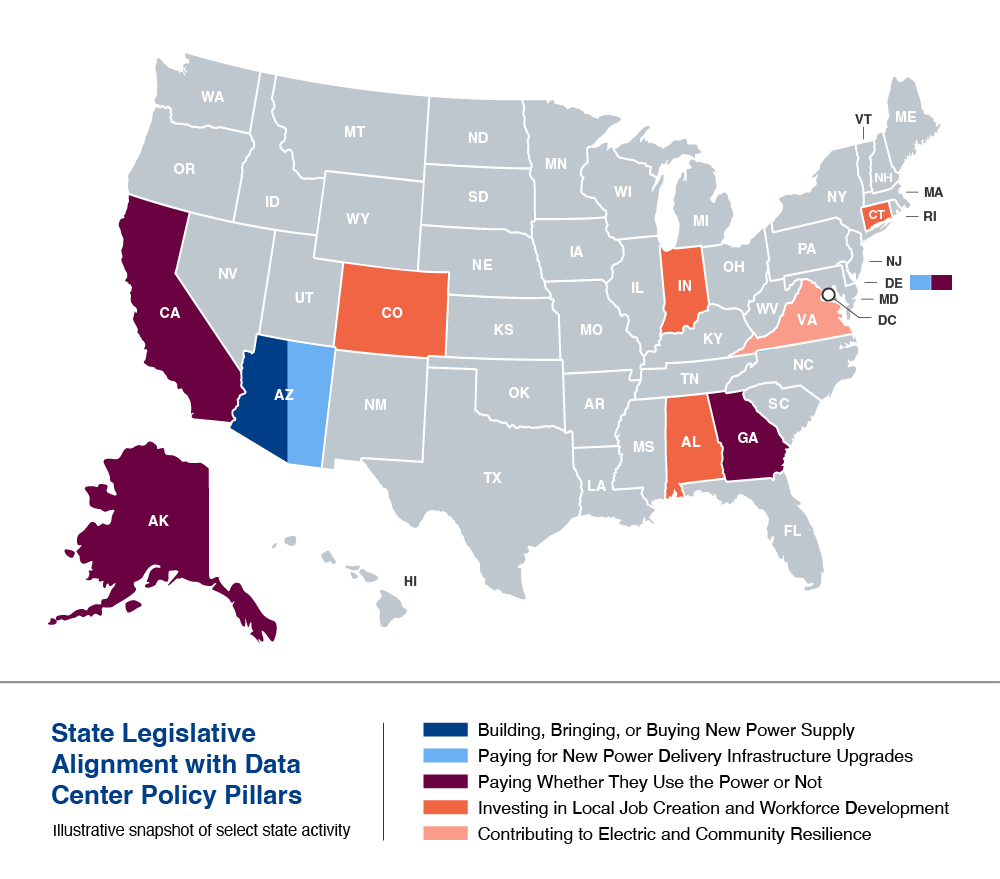
To mitigate infrastructure strain, five states are pursuing policies to mandate that developers are responsible for paying for new electric infrastructure upgrades required for their operations. This move also signals that data centers are partners in long-term planning and grid modernization. Arizona’s HB 2738 provides an example of this cost-shifting protection, requiring operators to submit "cost responsibility agreements" that mandate they pay for all upgrades required to serve their site. In Delaware, SB 205 proposes a "transmission certificate" for any business exceeding demand of 100 MW. These measures help reduce the complexity of infrastructure planning by requiring upfront capital commitments.
Other states are proposing new laws that balance incentives with local job creation and community resilience. In Alabama, SB 265 / HB 399, revise the state’s tax incentive model by limiting abatement periods to 20 years and requiring large data centers to pay state taxes on building materials and power infrastructure starting in 2027. In Connecticut, SB 43 updates the state's tax credit for machinery and equipment, requiring a five-year minimum use period to ensure long-term corporate commitment. Indiana’s HB 1333 requires data centers to share 1% of their sales tax exemption savings with local governments to support community needs. Meanwhile, Colorado’s HB 1030 establishes a Data Center Development and Incentive Program that requires developers to meet strict prevailing wage and apprenticeship standards to qualify for exemptions. These proposals can help mitigate workforce concerns by helping guarantee the industry’s contribution to job development needs.
A significant bipartisan and nationwide alignment is forming between state-led initiatives and federal guidance. While these state-level actions prioritize cost-shifting protections for consumers and pay your fair share they also help provide policy clarity for continued industry investments. These measures create a framework where capital for infrastructure growth can support both grid reliability, long-term economic growth, and affordability. The American data center sector is being shaped by state legislators as they address the intersection of economic growth, grid stability, and ratepayer equity.
Is your organization prepared for this shifting regulatory landscape?
As the 2026 energy landscape transforms, navigating the intersection of policy, power, and infrastructure requires a specialized lens. If you are wondering how these state-led initiatives or the federal Ratepayer Protection Pledge might impact your business operations, project pipeline, or energy costs, our Energy Practice Team is here to help. Contact us today.
About the Writer: Juan Gomez
Juan Gomez is the Senior Manager of Energy Policy at Stateside Associates. Prior to joining Stateside, Juan supported the US Department of Energy on a range of initiatives related to energy security, cybersecurity, emergency response and resilience. He has additional experience from global risk advisory firms and energy policy think tanks. Juan leads Stateside’s research efforts and contributes to strategic advisory for energy policy clients.
About Our Energy Practice
Stateside’s Energy practice, led by Taylor Beis, VP of Energy Policy, provides strategic guidance to clients across the ever-changing energy landscape. From optimizing clients’ participation in national membership organizations, to developing tailored strategic planning, policy guidance, and messaging, our dedicated energy policy consultants steer clients through the complex energy ecosystem.
Additionally, our energy practice performs legislative and regulatory monitoring that cuts through the uniquely challenging process environment of state legislatures, public utilities and service commissions, and rulemaking to inform companies of the opportunity to engage in the policy and regulatory process, or to confidently remain in compliance.
