



On August 25, 2026, the National Telecommunications and Information Administration, or NTIA, closed a chapter that has dominated state broadband policy for nearly two years: every one of the 56 Broadband Equity, Access, and Deployment (BEAD) Final Proposals, representing the 50 states, Washington, D.C., and five territories, have now been approved. Illinois was the last to cross the line, capping a process reshaped midstream by NTIA's June 2025 "Benefit of the Bargain" restructuring. That overhaul dropped the program's original fiber-first mandate for a technology-neutral approach, prioritized lowest-cost project proposals, and required states to run a new competitive bidding round under the revised rules.
It’s been a long road to unlock broadband infrastructure funding from the $42.45 billion program, originally passed in the 2021 Infrastructure Investment and Jobs Act under President Joe Biden. But for states, internet service providers (ISPs), and vendors, the real work is just beginning. Planning is over, and execution — finalizing subgrantee agreements, permitting, and construction — is next up.
Where BEAD Deployment Stands
Approval doesn't necessarily mean shovels in the ground — it means a state can sign its award agreement with NTIA, unlocking funds for selected ISPs. So far, 54 states and territories have reached that signed-agreement stage. Louisiana was first, already dispersing payments on a $1.3 billion buildout to reach about 130,000 locations. Nebraska recorded the program's first BEAD-funded household connection, delivered by a fixed wireless provider, in May.
Most states are now in, or approaching, construction, with groundbreakings likely to ramp up in fall 2026. In the meantime, state broadband offices are finalizing subgrantee agreements, ISPs are locking in subcontractors, and competition for a shrinking pool of construction labor is likely to intensify. According to an analysis by The Pew Charitable Trusts, 41 states and D.C. identified workforce challenges — including worker availability, wages, competition, and job classification issues — as potential barriers to deployment.
Awaiting Guidance on BEAD Non-Deployment Funds
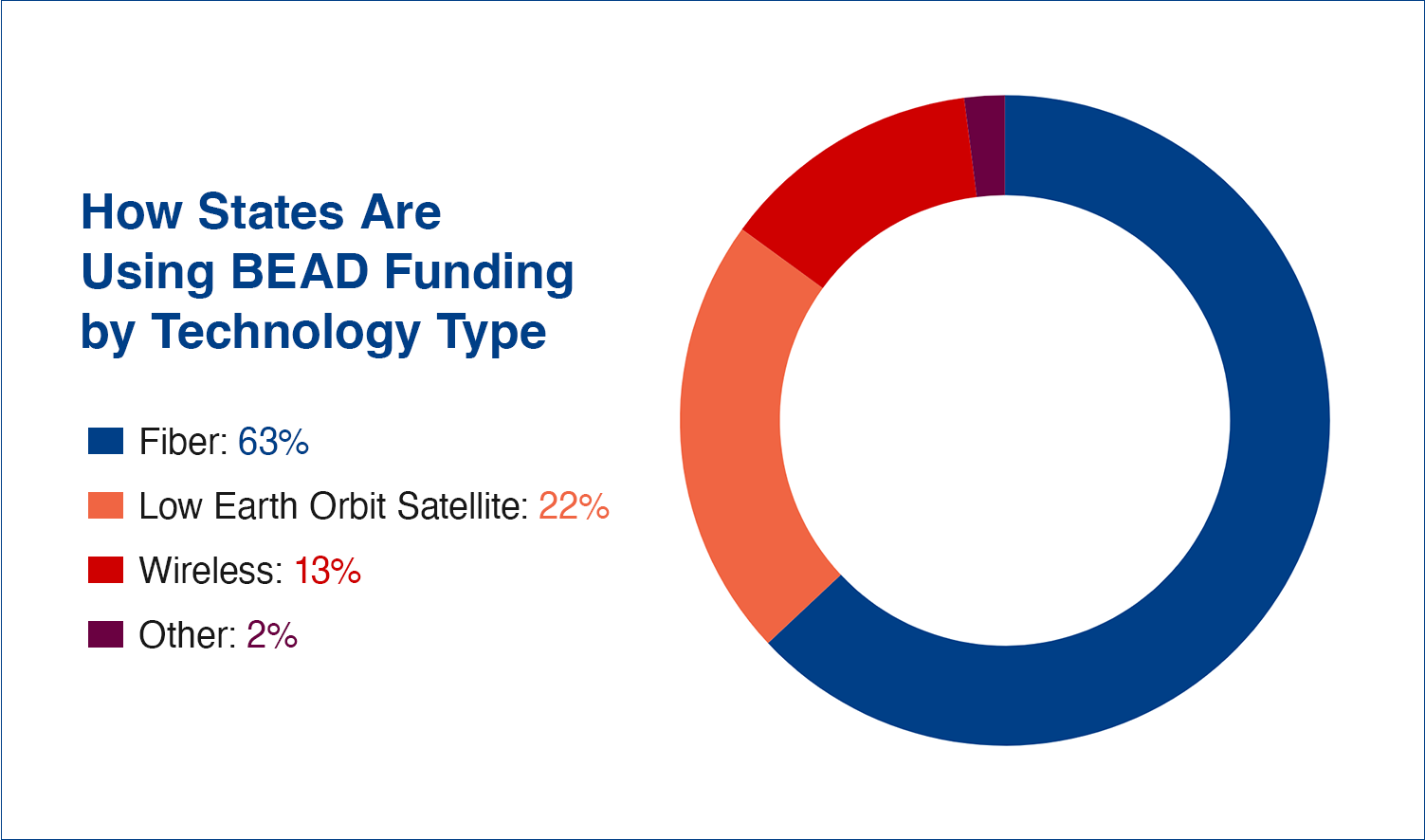
According to an initial analysis of BEAD Final Proposals, states and territories plan to spend $18.2 billion on broadband infrastructure to connect 3.79 million locations. What happens to the estimated $22.5 billion in “Benefit of the Bargain” savings — leftover BEAD funds not used for infrastructure deployment — is arguably the most consequential open question for states right now.
NTIA has signaled for months that states will get to keep and use these "non-deployment” dollars, with Secretary of Commerce Howard Lutnick affirming as much before the Senate Appropriations Committee in February. But the agency has repeatedly delayed formal guidance on allowable uses, and the debate over what qualifies is very much alive. NTIA Administrator Arielle Roth has said that guidance will come “this summer” and that she believes some of the money should be used to deploy Next Generation 9-1-1 — an internet protocol-based system — to upgrade 911 call centers nationwide.
Adding to the confusion: It’s still unclear how the Commerce Department will enforce President Trump’s December 2025 executive order threatening to make states with “onerous” AI laws ineligible to receive non-deployment funds.
Under the original, Biden-era BEAD guidance, non-deployment funds were intended to be used for broadband adoption programs, infrastructure upgrades, and workforce development. When the new guidance is finally published, it could effectively define a new, multibillion-dollar grant program.
What's Next for the Digital Equity Competitive Grant Program
The Digital Equity Competitive Grant Program has had a rougher road. Originally a $1.25 billion competitive fund within the $2.75 billion Digital Equity Act, it was terminated in May 2025 after the Trump Administration moved to end all Digital Equity Act programs. The National Digital Inclusion Alliance sued, and in July 2026, a federal judge ruled that the statute's inclusion of racial or ethnic minority status as a "covered population" was unconstitutional but severable — meaning the rest of the program could proceed without that provision.
That ruling appears to have opened a path forward. On August 25, NTIA took its first concrete step toward reviving the program, opening a 60-day public comment period on new information collection and application requirements. The agency is targeting a December 2026 application window for a new Notice of Funding Opportunity (NOFO).
Without the race-conscious provisions of the earlier program, the updated NOFO will focus on promoting broadband adoption among the remaining covered populations: low-income households, aging individuals, incarcerated individuals, veterans, individuals with disabilities, individuals with language barriers, and rural residents. State agencies, local governments, Tribes, and nonprofits interested in applying or re-applying for funding should consider engaging in the public comment period now, before the deadline of October 26, 2026, to shape the program.
The Bottom Line
The approval of all state and territorial BEAD Final Proposals marks the end of the planning era for the country’s largest broadband investment, but two big open questions — how non-deployment funds get spent and whether digital equity funding returns in a durable form — are still being decided. Stakeholders who engage early, prepare their strategy, and understand the new rules of the road will be best positioned to capitalize on these emerging funding opportunities.
Previous Blogs in this Series: Trump’s “National Framework” vs. State AI Laws
Stateside’s Technology Practice
Stateside's Technology Practice tracks state and local policy developments like these as they happen — from broadband and digital equity funding to AI regulation, data centers, and beyond. Whether you need real-time legislative and regulatory monitoring, strategic advocacy support, or a partner who can translate fast-moving policy shifts into a clear plan of action, our team helps clients stay ahead of the issues that matter to their business. Reach out to learn how we can support your state government affairs strategy.