



The 2026 election cycle is in the books and dynamics inside of state legislatures have shifted all across the country. Much of the conversation surrounding the 2026 elections from a state government perspective has centered on the 36 gubernatorial races and broad legislative chamber majorities that resulted in flips or new-found or broken supermajorities. However, hundreds of new state legislators will be sworn in entering 2027, replacing longtime lawmakers that have retired, are term-limited, or lost their races. These changes will result in shifts in legislative priorities and see new figures take on larger roles inside of state governance.
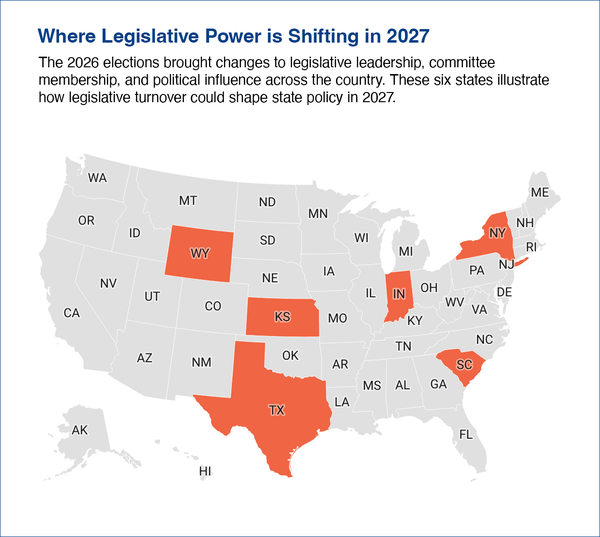
Indiana: New Leadership and Key Committee Vacancies
One of the most shocking upsets of election night occurred in Indiana, where Speaker of the House Todd Huston (R) lost to political newcomer Lauren Cole (D). Both Huston and Speaker-elect Ben Smaltz (R) identified national headwinds as a major cause of this upset. The Indiana House will now enter the 2027 legislative session with a new Speaker for the first time since 2020. Speaker-elect Smaltz outlined his top priority for the new session as affordability, including a possible extension of the gas tax holiday.
Smaltz will be working in a different political landscape than his predecessor, as 2027 will be the first time since the 2012 elections that Republicans do not have a supermajority in the Indiana House.
Smaltz may be best-known for sponsoring HB 1032 in 2025, the state’s effort to replicate mid-decade redistricting efforts seen in Texas and California. The bill passed the House successfully at the time, but ultimately failed in the Senate in no small part due to President Pro Tem Rodric Bray opposing the measure. Bray chose not to run for the Pro Tem position for next session, opening the door for Senator Chris Garten who has been selected by his caucus.
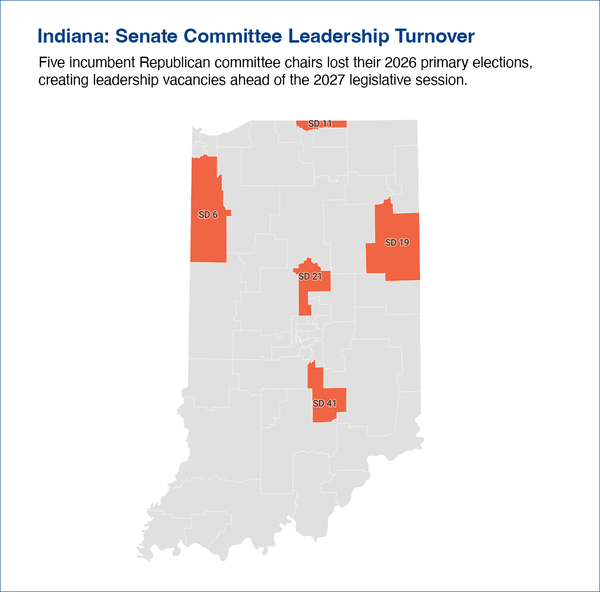
The new Senate President and House Speaker will have their work cut out for them as they prepare committee assignments and delegate committee chairs for the 2027 legislative session. The Indiana Legislature was among the bodies with the most electoral losses by sitting committee chairs. During the May 5 primaries, the chairs of the Senate Environmental Affairs Committee, Senate Local Government Committee, Senate Pensions and Labor Committee, and Senate Tax and Fiscal Policy Committee all lost their primaries. All five of these Republican Senators voted against their party during the chamber vote on redistricting in 2025, which may have contributed to their ousters.
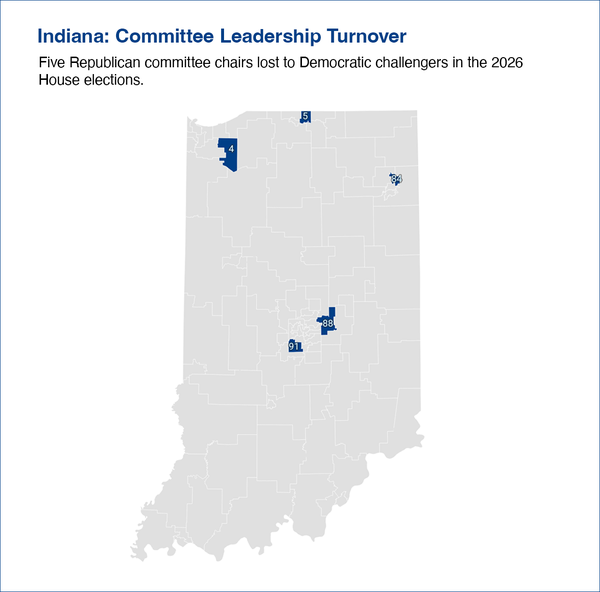
During the General Election, committee chairs of the House Commerce, Small Business, and Economic Development Committee, House Education Committee, House Family, Children, and Human Affairs Committee, House Judiciary Committee, and House Utilities, Energy, and Telecommunications Committee all lost their races to Democratic challengers. This turnaround will lead to new leadership, new staff, and new relationships dictating policy.
New York: Progressive Gains and the Tax Policy Debate
The shift to the left in New York that made headlines last year after then-Assemblymember Zohran Mamdani won the race for New York City Mayor continued in 2026 and resulted in several high-profile committee chairs being ousted from the New York State Legislature. Assemblymember William Magnarelli, the chair of the Assembly Transportation Committee, lost to Maurice Brown, a challenger from the left. Two committee chairs representing Brooklyn-based districts, Assemblymembers Stefani Zinerman and Erik Dilan, lost their primary races to democratic socialist candidates Eon Huntley and Christian Celeste Tate respectively. Four-term incumbent Senator Jessica Ramos, the chair of the Senate Labor Committee, lost her reelection bid to Assemblymember Jessica Gonzalez-Rojas, a member of the NYC Democratic Socialists of America (DSA), who cited Ramos’s endorsement of Andrew Cuomo over Mamdani in last year’s mayoral race as a reason for challenging her colleague.
In total DSA members will hold twelve seats in the Assembly and four in the Senate. While this bloc may not make up a majority, especially in a legislature that is as Democratic as any in over a century, they are sure to be a vocal participant in the Assembly Majority Leader race that is set to take place with the retirement of Leader Crystal Peoples-Stokes.
Additionally, this growing bloc may be able to help steer policy conversations. Tax increases are one area where the increased number of DSA members in the legislature may help advance policy initiatives. Increases to both income and corporate taxes have been a topic of conversation around Albany in recent weeks as a way to fund DSA-supported initiatives, including universal childcare.
Wyoming: A Shift in Republican Leadership
The national trend of legislative bodies shifting to the left was even seen in a state that will maintain strong Republican majorities in both chambers. After the 2024 elections, the Freedom Caucus maintained a majority in the Wyoming House of Representatives and elected a member of the Caucus as Speaker of the House, charged with appointing committees and assigning legislation. Many of the group’s priorities, including tackling diversity, equity, and inclusion initiatives at higher education institutions and cracking down on non-citizen voting and driving, failed to pass and caused rifts within the caucus at large. These failures, combined with a scandal involving checks being handed to Freedom Caucus members on the House floor by a conservative activist, led to major losses in the primaries for the Caucus.
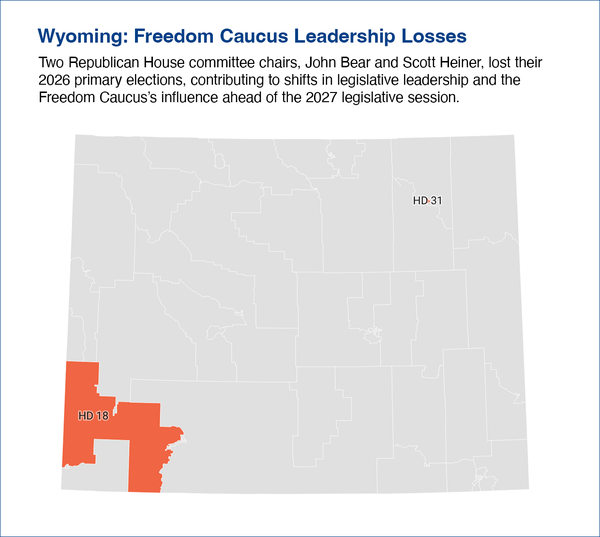
Among those who lost their primaries were House Appropriations Committee Chair John Bear and House Minerals, Business, and Economic Development Committee Chair Scott Heiner. Speaker of the House Chip Neiman, a member of the Freedom Caucus, will also not return for the 2027 session after a failed attempt at a State Senate seat. During the general election, more Freedom Caucus members lost their seats, leaving the group with roughly ten votes in the House going into the 2027 session.
These races will have major ramifications for leadership elections. Leadership in the House and Senate are expected to align closer with the Republican caucus at large, a shift from last session where House leadership regularly butted heads with the Senate and Governor Mark Gordon. Neither of the declared candidates for Speaker, Representative Lloyd Larsen, who was the target of a Freedom Caucus mailer last election cycle, and Representative Art Washut, are members of the Freedom Caucus. Presumed Senate President Tara Nethercott has faced regular backlash from the Freedom Caucus, as has Governor-elect Eric Barlow.
The more unified political affiliations of leaders across Wyoming government may have an impact on the types of legislation that get introduced and what ultimately passes going into 2027. Barlow has vowed to prioritize healthcare initiatives in his new administration, including expanding telehealth, expanding rural hospital networks, and growing the state’s healthcare workforce.
Texas: A New Lieutenant Governor and a Deliberation Over Senate Power
Among the most impactful races of the night was the Texas Lieutenant Governor race where Democrat Vikki Goodwin defeated twelve-year incumbent Dan Patrick. Due to the nature of Senate rules, Lieutenant Governor-elect Goodwin will have significant influence over the Republican-held Senate. This includes presiding over the Senate, appointing committee members and chairs, and assigning legislation to specific committees.
Patrick has already called on the Republican-held Senate to remove some of these powers to protect the influence of Republicans in that chamber after both the House and governorship flipped blue.
Two areas to watch for legislative action now that Patrick is out of office are gambling and marijuana legalization. Patrick is a staunch opponent of both and frequently killed any legislative efforts. While LG-elect Goodwin has expressed support for hemp industry in the state, her thoughts on a broader marijuana legalization attempt are unknown.
Quick Hits
Kansas: Uncertainty Over the Next House Speaker
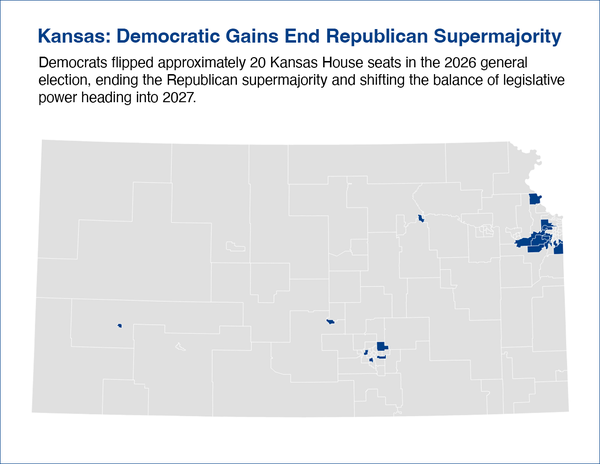
Kansas Speaker of the House Dan Hawkins left the House to run for Insurance Commissioner. His presumed replacement, Majority Leader Chris Croft, is currently losing his bid for reelection, leaving a vacuum that must be filled in the Kansas House. The new Speaker will be presiding over a chamber that saw Democrats flip approximately twenty seats on November 3, ending the supermajority that has been instrumental in overriding Democrat Governor Laura Kelly’s vetoes since she was elected in 2018. With Democratic State Senator Cindy Holscher leading in the race to replace Kelly, the lost supermajority in the Kansas House could impact what passes the chamber.
South Carolina: Another Majority Leader Vacancy
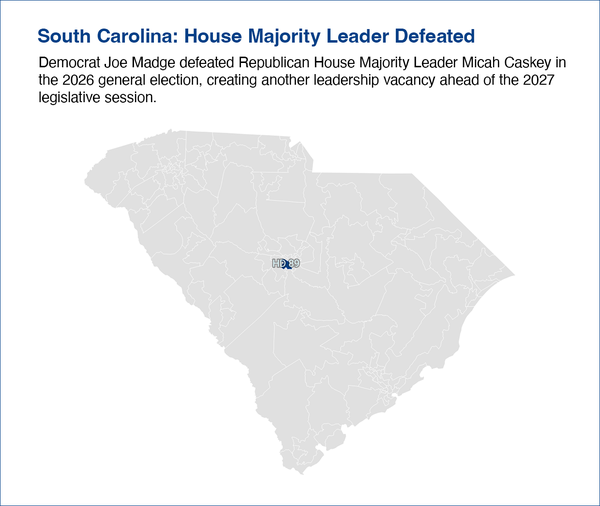
For the second time this year, South Carolina House Republicans will be looking for a new Majority Leader. Representative Micah Caskey, who assumed the role in September after the previous Majority Leader announced his retirement, lost his election to Democrat Joe Madge in one of the closest races of the evening. Republicans will have until December to identify a new Majority Leader to advocate for their party’s platform in a House that no longer has a Republican supermajority.
Preparing for the 2027 Legislative Sessions
These are just a handful of the hundreds of changes that will impact state legislatures in the 2027 legislative session. Hundreds of new legislators will enter state capitols, sit on committees, and introduce legislation that will impact organizations across every industry.
To stay on top of all that is expected during the upcoming year, or to help start building relationships with the newest power players in the states, reach out to Stateside Associates. Our Legislative Department is already reviewing prefiles and our Issue Management team can help your team identify and engage with key legislators for your organization.