


Key Takeaways
- State drone legislation has hit an inflection point. With 38 states introducing UAS bills and 23 already enacting new laws, drone policy has become a mainstream legislative priority in nearly every state capital.
- The Safer Skies Act gave states new counter-UAS authority — now they're racing to be ready. Congress authorized state and local law enforcement to counter drone threats for the first time in December 2025, but the federal regulations governing training and approved equipment are still pending from DHS and DOJ.
- Major events are pushing states to act. Between the World Cup and America 250, host states are fast-tracking no-fly zones and counter-UAS legislation — backed by $250 million in federal mitigation funding — before the regulations are even final.
2026 State Drone Legislation Activity
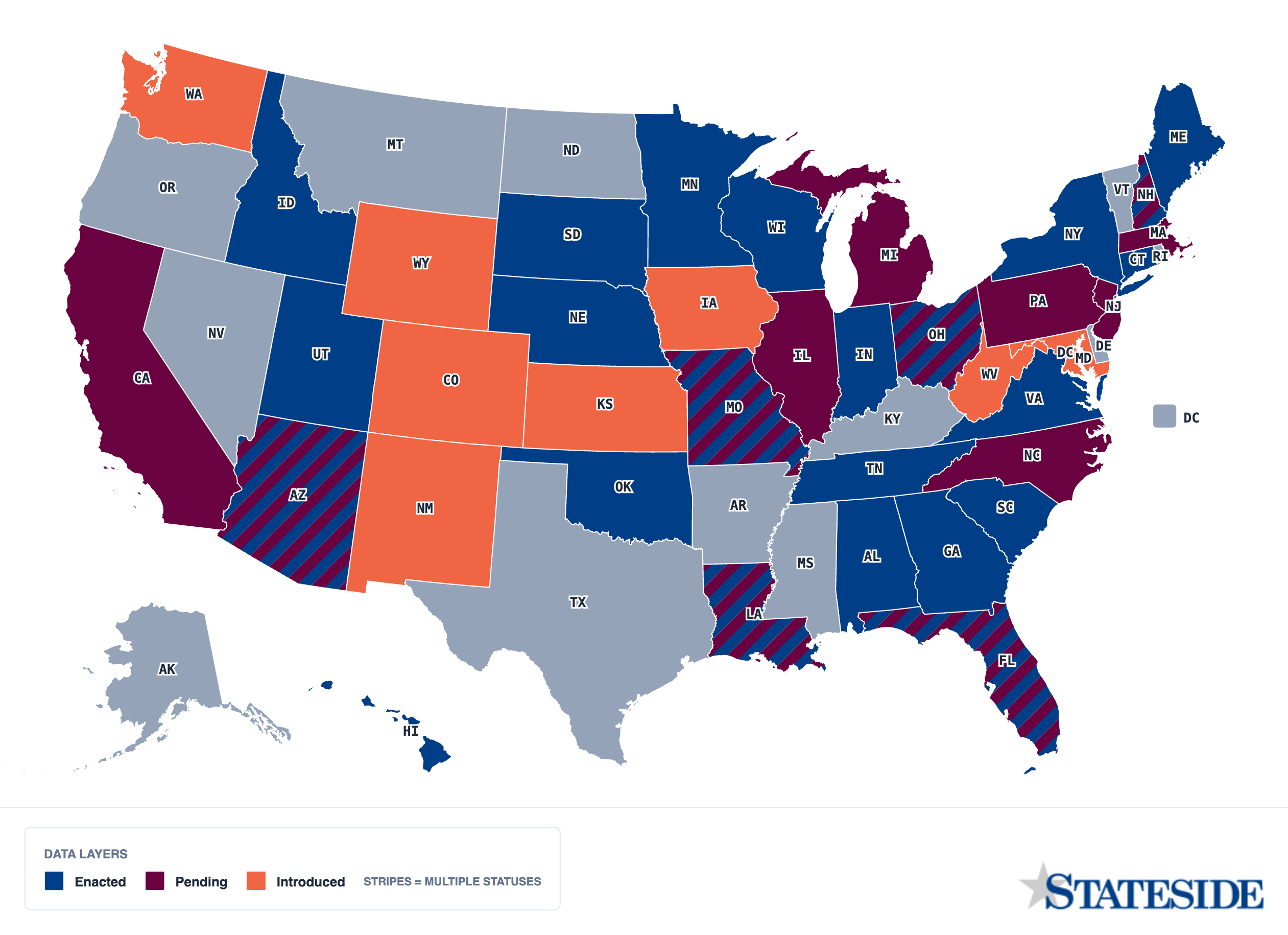
State legislatures have been remarkably active on drone policy this year. As of June, 38 states have introduced unmanned aircraft systems (UAS) legislation, 23 have enacted new laws, and 13 still have bills pending. The activity clusters around three major themes: drone mitigation, flight restrictions, and procurement security — and together they paint a clear picture of where state-level UAS policy is heading.
Mitigation authority is expanding
Until December 2025, only a handful of federal agencies could legally take down a threatening drone. The Safer Skies Act changed that, giving trained state and local law enforcement the green light to detect, track, and disable drones that pose a credible threat. The Department of Homeland Security and the Department of Justice are due to publish implementing regulations — covering training standards, the authorized equipment list, and compliance oversight procedures — this month.
Prompted by the passage of the Safer Skies Act, a growing number of states are giving law enforcement and corrections agencies new tools to counter unauthorized drones near sensitive sites. South Dakota's HB 1280, signed by Governor Larry Rhoden in March, authorizes mitigation against drones unlawfully operating over prisons, jails, and military facilities. Idaho's HB 522 grants similar authority to the Department of Corrections and law enforcement for drones operating "in a nefarious manner" within restricted airspace. Georgia's HB 1230 and Alabama's HB 274 take aim specifically at drones operating near correctional facilities — a problem that's become increasingly common as drone technology gets cheaper and more accessible.
Indiana's SB 227 stands out as a more cautious model: it establishes a statewide counter-UAS framework, but only activates once federal law authorizes state or local agencies to detect, track, or mitigate unlawful drones, and limits tactics to those federally approved. This "wait for federal cover" approach may appeal to states wary of overstepping FAA authority while still building the legal infrastructure to act quickly once the federal green light arrives.
No-fly zones are multiplying
States are carving out drone-free airspace around schools, ticketed events, critical infrastructure, and government buildings. Tennessee enacted two separate bills — SB 2434, barring surveillance flights over K-12 schools without administrator permission, and HB 2368, prohibiting drones within 400 feet of or above ticketed events. Wisconsin did much the same, restricting drones over schools during school hours and events, and separately banning low-altitude flights near critical infrastructure. Alabama restricted drone operations near ticketed events, while Louisiana barred unauthorized flights over the state capitol grounds. Maine went further, creating a specific criminal offense and penalty schedule for unauthorized drone use over correctional facilities.
Foreign-made drones face new procurement bans
Following the FCC's 2025 blacklist of foreign-made drones and components over national security concerns, states have begun writing similar restrictions into their own procurement law. Tennessee's HB 548 bars state agencies from procuring UAS—or any information and communications technology — from "foreign adversary companies," and bars those companies from bidding on state contracts altogether. New Hampshire's HB 1444 prohibits state and local governments from acquiring drones that don't meet National Defense Authorization Act standards or that appear on the FCC's covered list.
Why now?
Two major events are accelerating this wave. The World Cup prompted several host states — including California, Massachusetts, Missouri, and Georgia —to move quickly on drone restrictions ahead of large public gatherings. Missouri's sweeping public safety bill, passed in May, bundles flight restrictions with mitigation authority, and California is weighing a similar 400-foot restriction around outdoor ticketed events. Separately, the America 250 celebration is prompting counter-drone measures in states and the District of Columbia hosting commemorative events. Eleven states plus D.C. have already received a combined $250 million in federal funding for drone mitigation tied to these two occasions.
Looking ahead, this momentum shows no signs of slowing. With 13 states still actively considering legislation and the federal Safer Skies Act poised to grant states broader mitigation authority, more states are likely to adopt counter-UAS laws, expand no-fly zones around prisons and critical infrastructure, and tighten procurement rules around foreign-made drones. The growing accessibility of drone technology and high-profile upcoming events, like the Summer 2028 Olympic Games, also point toward a continued uptick in UAS-focused legislation in 2027.
Stateside's Technology Practice tracks UAS policy and other emerging technology issues across all 50 states in real time, giving clients the context and analysis needed to stay ahead of the curve. We can help you understand what's coming and how to respond. Contact us today to learn more.