



Executive Summary
- Current Regulatory Landscape: In 2026, state health agencies are changing opioid treatment program regulations by expanding practitioner scope, revising prescription and dosing guidelines, redesigning facility operations, and amending coverage and harm reduction provisions.
- Ongoing Challenges: Despite the recent decline in drug overdose mortality, barely anyone living with a substance use disorder has continuous access to treatment, and state regulatory restrictions on opioid treatment programs (OTPs) persist.
- Policy Recommendations: State regulatory agencies should align OTP rules with SAMHSA’s 2024 rules, permit providers to base medications for opioid use disorder (MOUD) dosing on individualized patient needs, and state legislators should remove certificate of need restrictions on OTP facilities.
Over the past few years, America has experienced a decline in drug overdose mortality thanks to medications for opioid use disorders (OUDs). Drugs like buprenorphine, naltrexone, and methadone have helped to combat the opioid crisis; however, not many people with substance use disorders (SUDs) have sustained access to care. According to SAMHSA, less than 10% of people with an SUD have continuous access to appropriate care and just 6.3% of individuals who faced an illicit drug or alcohol use disorder in the previous year reported receiving treatment. Substance use disorders (addiction to drugs and alcohol) cause physical and psychological damage while placing a greater strain on the healthcare system. In 2026,[1] state health agencies advanced various rules shaping opioid treatment programs (OTPs) by expanding practitioners’ scope and authority, altering the prescribing and dosing guidelines, updating OTP facility operations and delivery systems, and amending rules related to coverage and harm reduction.
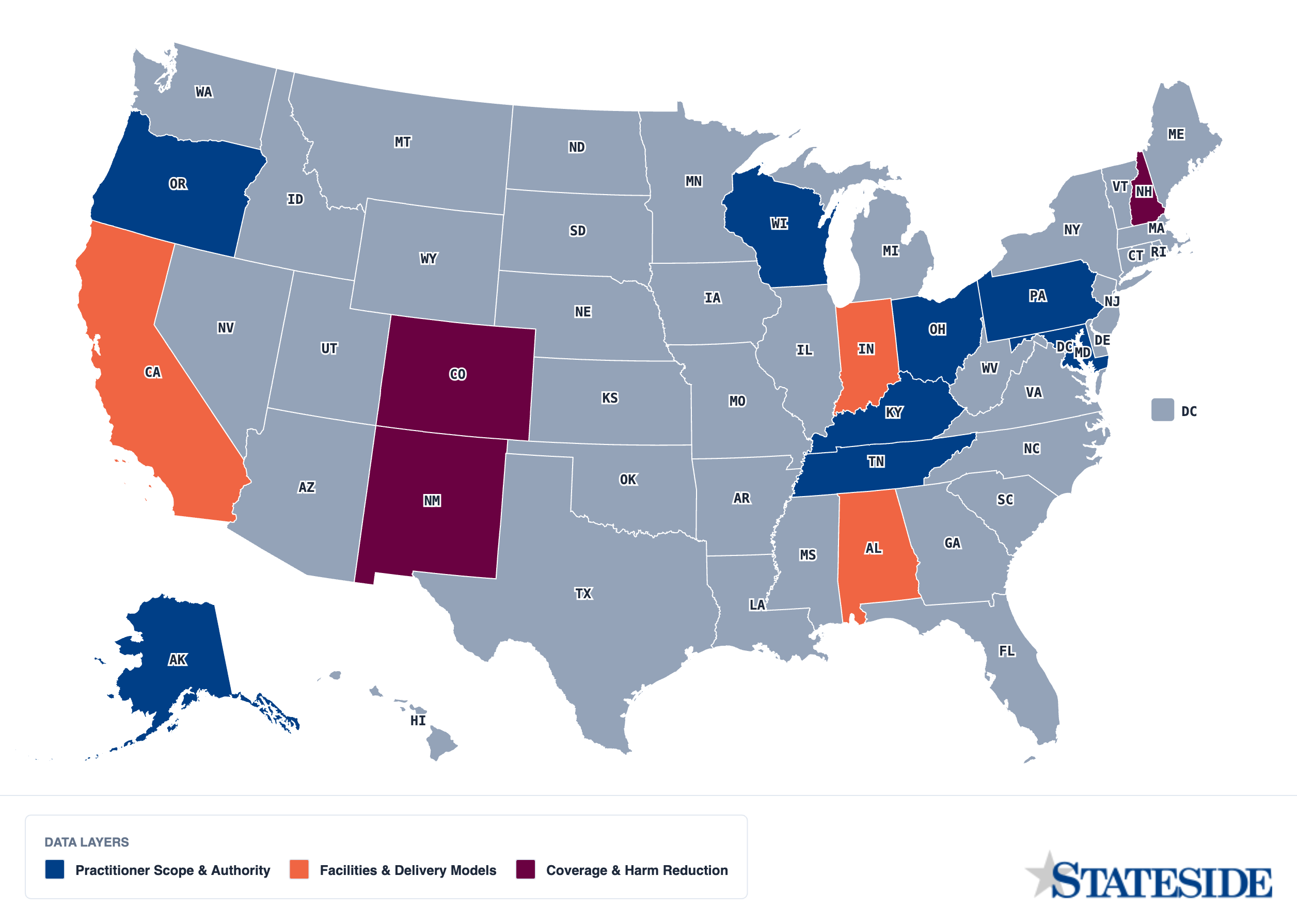
Practitioner Scope and Authority
Expanded Pharmacist Autonomy
State boards of pharmacy are expanding pharmacist autonomy in managing opioid use disorders by allowing care outside of traditional hospital settings. New Mexico adopted rules authorizing consultant pharmacists in institutional settings[2] to store dangerous drugs for medically monitored withdrawal management and allowed them to return sealed single-drug unit doses to stock to cut back on unnecessary pharmaceutical waste. Similarly, Ohio proposed a rule enabling pharmacists working under a consult agreement to administer controlled substances to treat OUDs outside of an OTP setting. By doing this, Ohio and New Mexico are developing a pathway for patients to receive on-site care without hospital admission delays. Finally, Oregon issued a temporary administrative order adopting revised protocols concerning the initiation, continuation, and modification of OUD care.
California proposed a rule that would have allowed pharmacists to initiate and manage medication-assisted treatment (MAT); however, they withdrew the rule after AB 1503 transitioned pharmacy practice to a standard of care practice model. Since this model grants pharmacists the ability to initiate prescriptions under the “accepted standard of care”, additional rulemakings would be redundant and unnecessary.[3]
Prescribing and Dosing Guidelines
Alaska finalized rules allowing providers to prescribe buprenorphine for opioid treatment without being physically present. This rule allows OUD to be managed remotely, helping patients to bridge the gap between practitioners and treatment. This change makes a major difference, particularly in Alaska, where many residents live in remote areas. Alaskan urban areas have 300 physicians for every 100,000 residents, more than double the 141 physicians per 100,000 residents in Alaskan rural areas.
Kentucky adopted rules establishing that licensed buprenorphine prescribers shall recommend in-office observed initiation, especially for fentanyl and methadone users, with resources to manage precipitated withdrawal. Encouraging in-office observation could benefit OUD patients since the care team can serve as their support network. Though these benefits depend on the patient, some may be more comfortable initiating treatment at home. The main benefit of in-office initiation is to prevent a precipitated withdrawal, which is more likely if a patient takes the first dose of buprenorphine too early. Kentucky’s rules also cap the buprenorphine dosing frequency at twice daily; however, this could conflict with clinical guidelines. The American Society of Addiction Medicine (ASAM) emphasizes that dosing frequencies should be individualized based on patient needs, making a blanket dosing cap unsuitable for OUD treatment.
Ready to navigate health care policy with confidence? Contact our team today.
Maryland and Alaska updated their prescription requirements for buprenorphine to align with federal updates. Prior to the Consolidated Appropriations Act (CAA) of 2023, practitioners were required to obtain a DATA 2000 X-Waiver to prescribe certain Schedule III-V medications, including buprenorphine for OUD treatment. This Act eliminated the waiver requirement, so both states codified the change to only require prescribing practitioners to be registered with the DEA with Schedule III authority, thereby increasing access to prescribers who treat OUD.
The Tennessee Medicaid Agency modified their coverage guidelines for prescribing buprenorphine to treat OUD. Notably, they doubled the maximum allowable daily dose of oral buprenorphine from 16 mg to 32 mg per day, removed a six-month cap on treatment duration, added utilization management processes to match prescribed doses with patient data, and required providers to use the lowest effective dose and initiate discussions about tapering down or off the patient’s treatment. Tennessee is shifting toward Medicaid policies that grant providers greater latitude in how they treat OUD, while integrating oversight mechanisms, ultimately constructing a more adaptable and responsive framework for patient care.
In accordance with federal updates, Wisconsin is updating its rules to authorize prescribers to treat more than 30 people for OUD using Schedule III buprenorphine. The initial patient cap artificially and arbitrarily limited treatment, so removing it gives prescribers the go-ahead to scale up OUD treatment for the community needs.
Professional Education and Licensure
Only two states have altered the education and licensure requirements for opioid treatment. In New Mexico, the continuing education required for pharmacists who prescribe opioid antagonists for overdoses was slightly reduced for licensure renewal, making it easier for pharmacists to maintain their credentials to treat OUD and preserve access for patients experiencing withdrawal. This is especially crucial for New Mexico which had the 5th highest overdose death rate in 2024 according to CDC data. And in Pennsylvania, the Board of Pharmacy proposed rules mandating that pharmacists applying for licensure must complete 2 hours of education in pain management or addiction and 2 hours in prescribing or dispensing opioids within 1 year of acquiring their license. The Board also proposed removing the requirement that pharmacists and pharmacy interns must complete immunization training within three years of applying for authorization. These regulatory developments reveal how states are redesigning and simplifying their administrative processes while strategically enhancing training for OUD management.
Facility Operations and Delivery Models
Alabama finalized a rule that made sweeping changes to opioid treatment program operations. For instance, admission criteria were loosened by replacing the requirement that adults must have 1-year of physiological opioid dependence before admission with a more general diagnosis of moderate-to-severe OUD or high risk for overdose. Admission restrictions for adolescents were also removed, previously mandating that they fail two treatment attempts and gain state approval. Now, adolescents must only obtain written consent from a parent, guardian, or state authority, which could drastically reduce delays to adolescent care.
California issued guidance notifying SUD facilities about statutory changes under AB 1037. The law prohibits SUD treatment facilities from denying admission, or requiring abstinence before admission, for individuals who have consumed drugs or alcohol, as these are the exact symptoms that necessitate treatment. It also specifies that licensees are not required to discharge residents who relapse and must develop a plan to address this. California is also renewing a 5-year waiver that integrates specialty mental health and SUD services into one behavioral health managed care delivery system. This contrasts with the existing system where specialty mental health services and SUD services operate under separate county contracts, requiring patients with mental illness and addiction to navigate two distinct systems. This change would merge both service types under a single county contract and one behavioral health plan, simplifying treatment for Californians.
Indiana proposed the creation of medication units and mobile medication units, respectively serving as stationary and vehicular-based modes of opioid treatment. The rules establish allowable distances from the affiliated OTP, security protocols, staffing and personnel requirements, operational alignment with the unit’s affiliated OTP, and permitted services (dispensing medications, drug screening, and bottle recalls).
Ready to navigate health care policy with confidence? Contact our team today.
Coverage and Harm Reduction
The remainder of rulemaking activity focuses on coverage and harm reduction. Regarding coverage, Colorado updated its insurance regulations to broaden the definition of “medication-assisted treatment” from focusing only on OUD treatment, to a more inclusive definition that encompasses SUD treatment. And New Mexico submitted a state plan amendment which was approved by CMS to permanently establish a mandatory Medicaid benefit for OUD medications.
Regarding harm reduction, New Hampshire proposed rules allowing opioid overdose treatment drugs to be dispensed in ambulatory patient treatment areas without having to identify the patient on the labeling. And New Mexico adopted rules to align with federal regulations in CFR Part 8 of Title 42 which were effective on April 2, 2024. The rules expand access to OUD treatment medications, remove stigmatizing language and practices, and support a patient-centered approach.
Policy Recommendations
State regulatory agencies that have not already done so should leverage existing federal regulatory changes to update how their opioid treatment programs operate. Agencies should completely align their OTP rules with SAMHSA’s 2024 rules which would, among other changes:
- Remove the requirement that individuals demonstrate 1 year of opioid addiction history before admission;
- Eliminate outdated and stigmatizing language while advancing evidence-based practices and patient-centered treatment activities;
- Update criteria for allowing take-home doses of methadone;
- Allow patient screening via telehealth;
- No longer make access to medication contingent upon receipt of counseling; and
- Permit nurse practitioners and physician assistants to order medications for opioid use disorder (MOUD) to dispense at the OTP.
States should also allow healthcare providers to base MOUD dosing frequencies and amounts on individualized patient needs rather than imposing arbitrary caps that hinder the effectiveness of treatment.
State legislators should make it easier for OTP facilities to exist. There are still 20 states that require OTPs to obtain a certificate of need before they can operate, among several other restrictions placed on them. State legislators should take action to remove such restrictions that limit access to already restricted care. OTPs are the only facilities authorized to offer all three FDA-approved medications for OUD.[4]
Conclusion
When it comes to opioid treatment programs, the regulatory environment is particularly restrictive. State legislators and regulators are uniquely positioned to counteract the ongoing opioid crisis, and by adopting the recommendations outlined here, they can shape the law to ensure that some of their most vulnerable residents receive the treatment they need.
About the Writer: Cody Austin is a Senior Regulatory Associate for Stateside's Healthcare Practice. He moved from western New York to Washington, D.C. to pursue a career in public policy, receiving his Master of Arts in Government from Johns Hopkins University in May 2025. Cody spends his free time running, volunteering, reading, and exploring DC with his corgi named Waffles.
Stateside’s Healthcare Practice helps organizations anticipate and respond to the legislative and regulatory changes reshaping healthcare at the state and federal levels. From Medicaid financing and reimbursement policy to implementation timelines and state-specific requirements, our team provides the intelligence and strategic guidance clients need to understand their exposure and prepare for what comes next. As H.R. 1 and CMS’s proposed rule threaten significant reductions to state-directed payments, healthcare providers, plans, and stakeholders must assess the potential impact now.
Contact Stateside to understand how these changes could affect your organization and develop a strategy for navigating the evolving Medicaid funding landscape.