
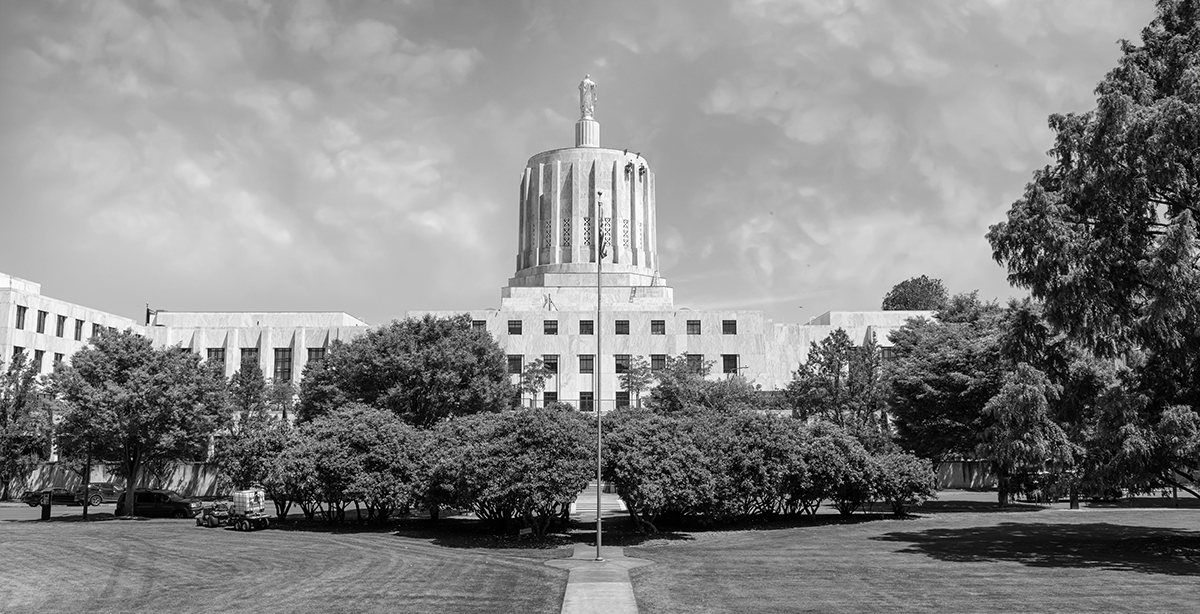


The Oregon Legislature adjourned on March 6 after its 35-day “short session” that occurs in even-numbered years. The House introduced 183 bills and the Senate 103 for a total of 293 bills. Of those bills, 28 have been enacted into law by Oregon’s governor, Tina Kotek (D). Governor Kotek has 30 days to sign or veto legislation once it is sent to her.
At the beginning of the legislative session, Governor Kotek outlined her priorities for the 2026 legislative session, highlighting policies that would help expand the economy while increasing job creation.
Consumer Finance Loans
In an effort to regulate state-chartered banks, Representative Nathan Sosa (D) introduced HB 4116, which opts the state out of Section 521 of the federal Depository Institutions Deregulation and Monetary Control Act of 1980 (DIDMCA) for consumer loans made in Oregon. This measure prohibits out-of-state state-chartered banks from utilizing DIDMCA to charge consumer loan interest rates above Oregon’s 36% cap. Many Democrats have spoken in support of the measure, with Senator Courtney Neron Misslin (D) urging that the legislature “cannot allow this loophole to permit digital loan sharks to continue undermining a consumer safeguard that has served [Oregon] well.”
This bill comes in the wake of the Tenth Circuit’s decision upholding Colorado’s DIDMCA opt-out legislation from 2023. If HB 4116 is enacted into law, Oregon would join Colorado, Iowa, and Puerto Rico as the only states/territories to opt out of the federal rate preemption. The only other state currently considering opting out of DIDMCA via legislation is Rhode Island.
This measure would apply to all consumer finance loans made in the state on or after June 5, 2027. The bill has passed both chambers and awaits the governor’s signature or veto.
Economic Development and Data Centers
In an effort to advance the Governor’s “Prosperity Roadmap” to maintain economic growth in the state despite federal uncertainty and budget cuts, Governor Kotek championed the Prosperity Roadmap Package (HB 4084). Introduced by the House Economic Development Committee, HB 4084 creates a tax credit for those engaged in a qualified industry for each new job created in bioscience and biotechnology, clean technology, food and beverage processing, and more. The tax credit is $1,000 per new job, with a maximum of 10 new jobs certified per tax year.
Additionally, this measure expands the state’s Enterprise Zone program, offering local tax breaks to businesses when they make new investments in the state. This provision has sparked controversy, as the proposed tax breaks would further incentivize data center construction despite the industry already securing $85 million in benefits through standard enterprise zones this year. This provision was heavily supported by Republican members serving rural areas of the state who have benefited from the arrival of data centers. Governor Kotek has expressed her concerns about the rise of data centers and the strain they are putting on Oregon’s energy grid. A last-minute amendment by Senator Jeff Golden (D) barred data centers and cryptocurrency mining operations from receiving the tax breaks. Governor Kotek expressed her support for the change, stating that it would “address immediate” concerns and spur further business development. If this bill is signed by Governor Kotek, the state is expected to issue $1.1 million of the credits in this budget.
Budget
Oregon runs on a Biennial Budget, meaning that a budget is passed every odd-numbered year to fund the state for the subsequent two fiscal years. In even-numbered years, the legislature will often pass a supplemental budget. Oregon began the year with a $63 million budget deficit. Although this deficit can be carried over into next year, the legislature still made a series of cuts. Along with the cuts, the budget that the legislature passed featured a series of new appropriations, including:
- $345,225,261 to the Oregon Health Authority for the Rural Health Transformation Program.
- $21,522,020 to the Department of Corrections for medications for opioid use disorder.
- $5,300,000 to the Oregon Department of Emergency Management for Next Generation 9-1-1.
What’s Next
2026 is an important election year for Oregon as voters are set to elect a governor, 15 state senators, 60 state representatives, and hundreds of local officeholders. Governor Tina Kotek announced her reelection bid in December 2025. State Senator Christine Drazan (R), who ran against Kotek in 2022, recently announced her second run for governor. Republican state Representative Ed Diehl (R) is also joining the race for the position. The statewide primary election will be held on May 19, 2026, and the general election on November 3, 2026.
The Oregon Legislature is expected to next convene in January 2027. The 2027 session is the long session, which will last up to 160 days. The Legislature will take up a new budget and issues discussed over the interim, which, if typical, will be very active. Oregon has a very active interim. Although no agendas have been released, they are likely to continue discussions regarding AI, healthcare, energy, affordable housing, and the budget.
To stay up to date on what will happen in the remaining state legislative sessions this year, reach out to Stateside to discuss legislative monitoring and reporting options.
