



State of Play
With less than two weeks left until the 2026 midterm elections, pundits and the political commentary are focused on which party will control the U.S. House and Senate, along with a handful of gubernatorial races. While the size and scope may be difficult to discern, what’s more challenging to predict, and often overlooked, are the impacts to down ballot races and potential administration and agency changes should there be Election Day surprises in governor races.
With 36 governor races up for re-election this year (19 open races and 17 incumbent governors seeking reelection) we will see significant shifts in administration appointments and state agency leadership as transition teams and newly elected governors begin outlining their policy priorities, deliver on campaign promises, and address high-priority issues on affordability and economic development. Now where is this more evident, or perhaps more impactful, than the potential changes and policy priorities that will impact the energy sector.
Over the course of the 2026 midterm election cycle, energy issues have dominated federal, state, and local issues. From rising oil prices and electricity rates to the impact of large load customers and affordability concerns to maintain our aging electric grid across the country. These trends, which we highlighted at the beginning of the year in our Energy and the 2026 State of the States analysis, are now center stage, as are the state regulatory agencies whose decisions impact utility rates and customer costs. Utility commissions, once behind-the-scenes state regulatory bodies, are now front and center + center stage in this debate and this year’s elections could cause seismic shifts in their makeup and the policy priorities shaping utility rates and investments for years, if not decades, to come.
By the Numbers: State Utility Commissions
In the majority of states (39 total) and the District of Columbia (39 total states), state utility commissioners are appointed by the governor, often requiring approval from the state legislature. In two states, the state general assembly appoints commissioners, and and the remaining states (10) elect their commissioners, either at-large or by district.
Across the 50 states and District of Columbia, 63 out of 210 utility commissioners will have their terms expire by the end of 2027. Of those with expiring terms, 48 seats will be filled through appointments.
Public Utility and Public Service Commissions: Appointed vs. Elected
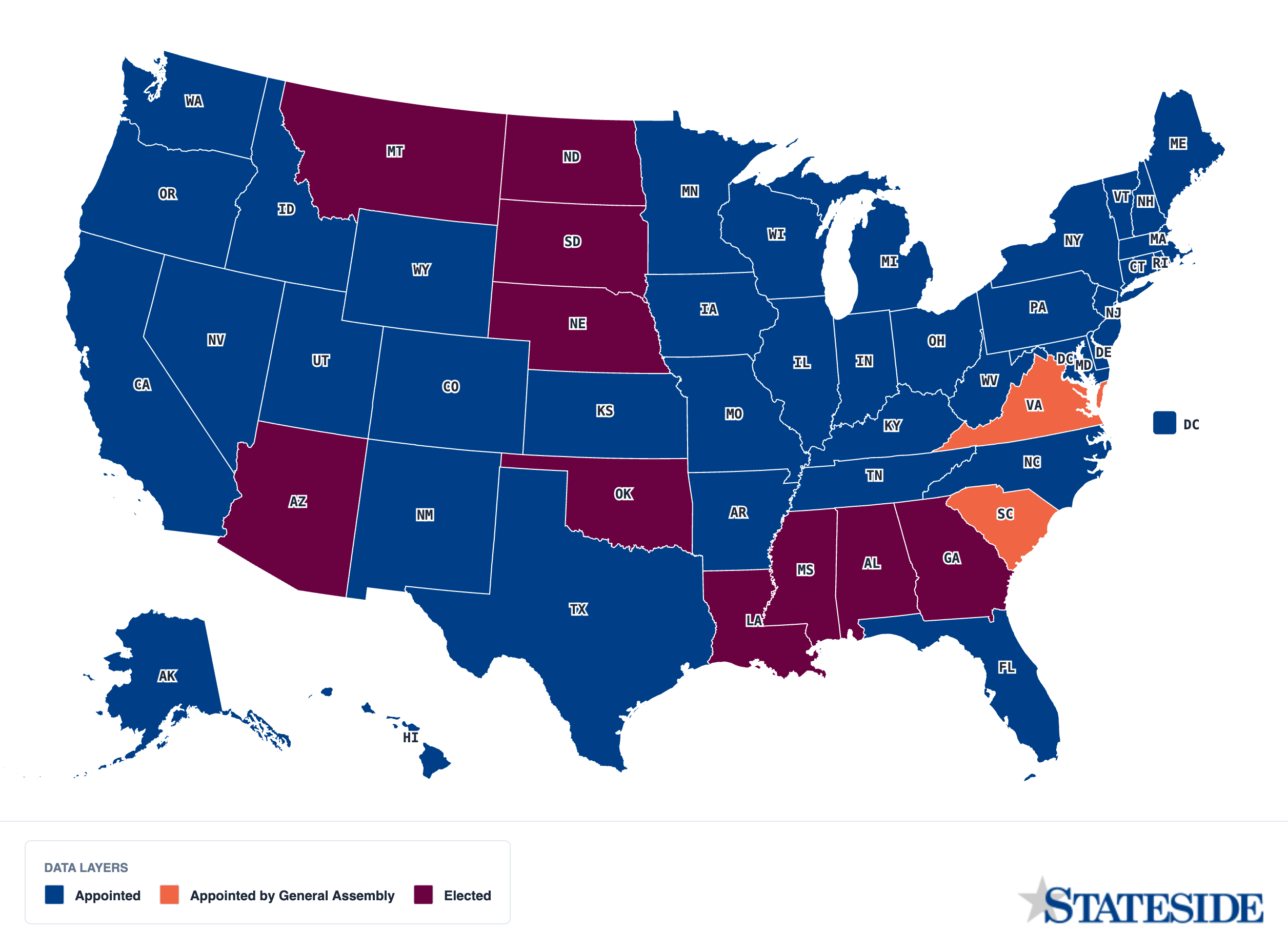
Gubernatorial races in Iowa, Ohio, and Wisconsin are considered highly competitive. All three states require nominees to be approved by the state senate. In these states, nominees could vary significantly based on which party prevails in November.
Term-limited gubernatorial races in California, Colorado, and Florida are not expected to be competitive but have expiring PUC seats. California is often considered one of the nation’s most influential utility regulatory bodies, so slight ideological deviations from outgoing Governor Gavin Newsom could lead to significant change in California and the region. While it’s unlikely to see significant changes in Colorado, it’s worth noting that cost of living and affordability issues could have broader implications as the state’s investments in geothermal and renewable energy led the nation in clean energy development in 2026. Similarly, in Florida, affordability issues have dominated campaign rhetoric, and the state is one of the nation’s fastest growing electricity markets in the country.
The remaining 32 appointments are in states where there is either no gubernatorial race, or the incumbent Governor is running for reelection. In Nevada, incumbent Governor Joe Lombardo (R) faces a strong Democratic challenger, meaningful changes may occur depending on November’s election outcome.
The remaining 15 seats will be filled via statewide or district elections on November 3.
Arizona, Georgia, Montana, North Dakota and Louisiana will each elect two of their five sitting commissioners. While Georgia does not have term limits, Arizona and Montana limit officials to two terms and Louisiana limits them to three.
Arizona will elect candidates to fill two expiring seats on the Arizona Corporation Commission (ACC). Each major party held a primary to nominate two candidates. Currently, all five statewide seats are held by Republicans. In the Republican primary, two incumbent commissioners ran for reelection. Incumbent Kevin Thompson (R) won renomination at the top of the race and state Representative Ralph Heap (R) narrowly defeated the other incumbent, Chairman Nick Myers (R).
In North Dakota, Jill Kringstad (R), who was appointed to fill a vacancy, is running for reelection to serve the remainder of the seat’s two-year term.
Following two incumbent upsets in 2025, Georgia now has two seats on the ballot this year, including one open seat race following former Commissioner Tricia Pridemore’s (R) decision to not seek reelection. Similarly, Montana will feature an open-seat race following Commissioner Randy Pinocci (R) decision not to seek reelection and to run for a state senate seat.
In Louisiana, District 1 and District 5 incumbents decided not to seek reelection, guaranteeing two new commissioners for their respective districts.
Alabama is undergoing a transition on the commission, and two seats are up for election in November. One incumbent, Commissioner Jeremy Oden (R), was defeated in the Republican primary. The other incumbent, Commissioner Chris "Chip" Beeker (R), advanced through the primary to the November general election. Alabama is guaranteed at least one newly elected commissioner following the mid-term election.
South Dakota, Nebraska, and Oklahoma will each elect one new commissioner. There is an incumbent in the running in Nebraska, while in Oklahoma and South Dakota there are no incumbents on the ballot, guaranteeing a new commissioner in each state.
In total, 8 incumbents are running for reelection, and the remaining 7 elected seats will be filled by new utility regulators.
Contact us to learn how Stateside can help your organization navigate the evolving energy policy landscape.
Looking Ahead: 2026 and Beyond
Beyond the gubernatorial outcomes impacting potential appointments and individual commissioner races in November, several other states are facing dramatic changes to their utility commission makeup through expiring terms as we look ahead to 2027.
In Massachusetts and Rhode Island, each of the state’s three commissioners will be replaced due to expiring terms. New York will replace four of its seven current commissioners, and Missouri and West Virginia will see two new appointments in 2027.
Additionally, we have seen several structural changes over the past several years impacting the makeup of state utility commissioners. In 2026 Alabama passed HB 475, the “Power to the People Act,” which expanded the number of seats on the commission from three to seven, based on congressional districts. In 2024, the North Carolina General Assembly passed legislation reducing the number of utility regulators from seven to five, and redistributed how those appointments are made, with the Governor and General Assembly each receiving two appointments, and the State Treasurer with one. Each appointment is subject to confirmation by the General Assembly going forward.
The 2026 midterm elections are proving to be a pivotal moment. While the country is focused on the outcomes this November, it’s important to remember the impact that newly elected governors, legislators, regulators, and other down-ballot races will have on state and local governments, industries, and your policy priorities.
Preparing for these outcomes, and the potential transitions that will inevitably take place, begins with building relationships with newly elected officials, mapping key staff and other stakeholders in the decision-making process, and aligning policy priorities with incoming administrations and key officials. This includes understanding the organizations key policy officials turn to for help, education, and support. For utility commissioners, and their staff, organizations such as the National Association of Regulatory Utility Commissioners (NARUC) is an important place to start building relationships and understanding the future policy environment for 2027 and beyond.
To learn more about how you can prepare, gain strategic insights, and develop your 2027 engagement plans, reach out to Stateside Associates or visit us at Stateside.com.
About the Writer: Taylor Beis – As Vice President of Energy Policy at Stateside Associates, Taylor Beis leads the firm's Energy Practice, advising clients on strategic policy initiatives related to electric power infrastructure and generation, clean energy technologies, and electric vehicles.
Prior to joining Stateside, Taylor was Director of External Affairs at the Edison Electric Institute (EEI). In this capacity, he led political and legislative engagement and outreach at the local, state, and federal levels on behalf of EEI and its member companies. Additionally, he managed the industry’s strategic relationships with union partners and stakeholders and identified and engaged allies on industry issues. Taylor has extensive experience working with state and local elected officials and their national membership organizations located in Washington, DC, and nationwide.
Research and Contributions: Special thanks to Tobias Zimmerman for his research and contributions to this post, and for his dedication during his recent internship at Stateside Associates.
Navigate Energy Policy with Confidence
As states adopt new approaches to grid reliability, affordability, and emerging technologies, organizations need a clear view of what is changing and what it means for their priorities. Stateside provides nationwide policy intelligence and strategic guidance to help you anticipate developments, assess risk, and engage effectively across all 50 states.
Contact us to learn how Stateside can help your organization navigate the evolving energy policy landscape.