
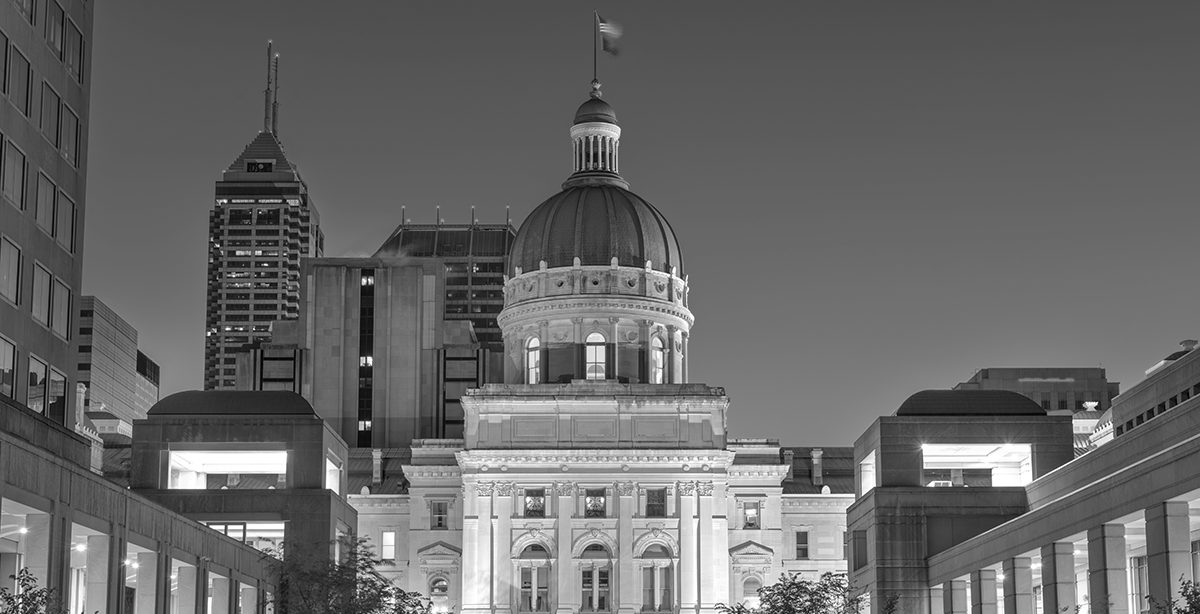


The Indiana General Assembly concluded its 2026 legislative session on February 27, marking the second legislative cycle under Governor Mike Braun’s administration. Lawmakers considered a wide array of proposals spanning economic development, healthcare, public safety, and election policy, with more than 800 bills introduced during the session.
As a short session in a biennial budget cycle, the legislature did not take up a new budget or supplemental appropriations measure, since the state’s two-year budget was enacted last year. Several bills were enacted into law, while others failed to advance or remain pending as they await final action from the Governor. The session featured several high-profile policy debates that shaped the state’s legislative agenda for the year.
Executive Orders
During the session, Governor Braun issued seven executive orders addressing administrative priorities across public assistance, workforce development, and state agency operations. One order directed agencies to strengthen verification and oversight in programs such as Medicaid and SNAP, supporting transparency and program integrity. Additional orders re-established the State Workforce Development Board, charged with coordinating workforce training and aligning employers, education providers, and state agencies on employment initiatives. Together, these executive actions complement the legislative measures passed during the session, reflecting a focus on administrative efficiency, program accountability, and workforce development.
Freedom and Opportunity Agenda
A central theme of the session was advancing Governor Braun’s Freedom and Opportunity agenda, emphasizing affordability, economic growth, and public safety. Legislative and executive actions aligned with these priorities, including measures to strengthen oversight of public assistance programs, improve workforce coordination, streamline utility regulation, and enhance regulatory flexibility for industrial and energy-intensive operations. The session also included policies to support education, local governance, and economic development, all aimed at expanding opportunity while maintaining protections for Hoosiers.
Health Care
Lawmakers approved legislation tightening eligibility verification requirements for Medicaid and food assistance programs, increasing oversight and documentation for recipients. SB 1 strengthens verification rules for Indiana’s Medicaid and SNAP programs by requiring more frequent eligibility checks, verifying immigration status for applicants, and establishing new work-requirement documentation standards. The bill also restricts the purchase of candy and soda with SNAP benefits and shortens eligibility periods.
State Senator Mike Gaskill praised the legislation, describing it as a significant step toward strengthening oversight of public assistance programs. “Senate Republicans passed our priorities, including landmark welfare reform aimed at ending waste, fraud, and abuse in the system,” Gaskill said. “This bill would strengthen the integrity of our public safety net while enforcing a zero-tolerance policy for illegal immigrants applying for Medicaid and SNAP benefits.” SB 1 passed the Senate 39–9 and now heads to the Governor’s desk.
SB 282 regulates compounding pharmacies and medical spas, particularly those offering injectable treatments and weight-loss medications. The legislation establishes clearer licensing and oversight requirements for providers administering compounded drugs in spa-like medical settings, aiming to improve patient safety and ensure proper medical supervision. This measure is also awaiting the Governor’s signature.
Environmental Regulations
The legislature considered several bills updating Indiana’s environmental regulations, shifting some enforcement requirements to discretionary authority. This change allows the Indiana Department of Environmental Management (IDEM) to adjust oversight based on facility type and risk while maintaining basic protections for air, water, and land. A significant focus of the session was on energy-intensive facilities, including data centers and utility infrastructure. Lawmakers worked to balance economic development with environmental oversight to ensure facilities operate efficiently without exceeding regulatory limits.
SB 240 clarified permitting and compliance procedures for industrial and energy-intensive facilities, giving IDEM the authority to tailor inspections and enforcement timelines to operational needs while retaining core environmental standards. HB 1002 streamlined water and air quality reporting requirements for certain facilities, including data centers, reducing administrative burdens while maintaining monitoring obligations. HB 1333, which would have expanded emissions monitoring and reporting for industrial operations, failed to advance, while SB 256 established guidance for renewable energy projects and infrastructure, particularly for commercial and data center developments, promoting planning and compliance with environmental standards in energy-intensive sectors.
What’s Next
Looking ahead to the 2026 midterm elections, Hoosiers will have multiple opportunities to shape both state and federal leadership. A primary election on May 5 will determine party nominees for federal, state legislative, and other offices appearing on the November ballot. The general election on November 3 will include contests for all 100 seats in the Indiana House of Representatives, 25 seats in the Indiana Senate, and federal offices, including Indiana’s nine U.S. House seats. As of publication, eight members of the House of Representatives and four Senators have announced they will not be seeking reelection to their seats.
To stay up to date on what will happen in the remaining 44 state legislative sessions this year, reach out to Stateside discuss legislative monitoring and reporting options.
